
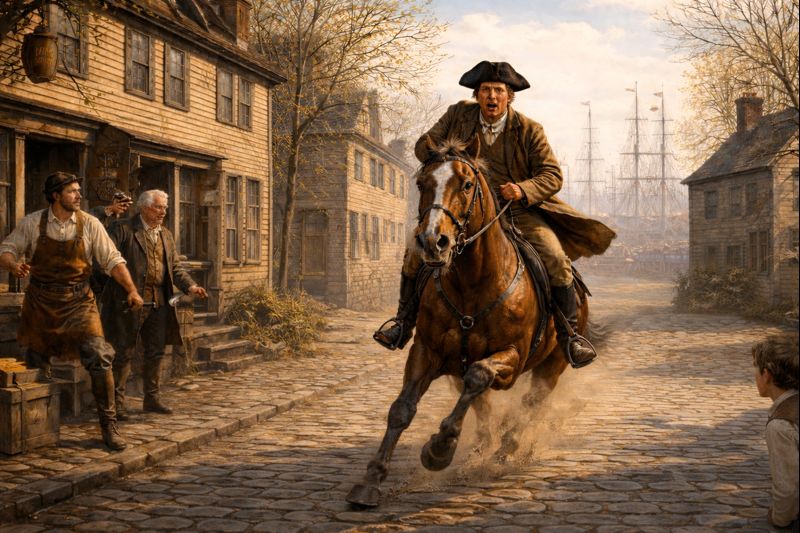
We might imagine a warm, sunlit afternoon in Plymouth, Massachusetts, on Wednesday, April 19, 1775—a day that began like any other in this seaside town. The winter had been unusually mild, and spring was already making itself known; green leaves were just beginning to unfurl on the trees, and the air carried the scent of salt and earth. Down by the wharves, fishermen mended their nets, farmers guided ox carts along the cobblestone streets. The crew of a schooner cast off lines, calling to one another as they prepared for a routine coastal voyage. Life moved at its familiar rhythm—though that peace would soon be broken by the thunder of approaching hoofbeats.
All eyes turn toward the source of the noise—an exhausted rider on a lathered horse clatters into town, shouting a stark and urgent alarm. With a garrison of 100 British Regulars stationed just a short march away in Marshfield, many in Plymouth no doubt feared that the long-anticipated move to occupy their town was finally underway. But the rider bore even graver news: British troops had marched out of Boston the night before, and blood had been shed that morning in Lexington. (It is likely the rider did not know of the later fighting at Concord, for reasons discussed below.)
Word spreads rapidly. Almost immediately, the narrow streets of Plymouth ring with the urgent shouts of militia companies mustering. Men who had drilled as minutemen all winter grab their muskets and their carefully prepared gear and rush to rally points. All across the South Shore and the Cape, the news that British soldiers have shed Patriot blood electrifies town after town.
This point bears emphasis—something I’ve come to appreciate more fully as I continue researching the South Shore’s role in the opening days of the Revolution. The movement on Marshfield, so often dismissed as a misguided action on the part of a few militia companies, was in fact a sweeping mobilization that drew in minutemen and militia from across Plymouth and Barnstable Counties.
As one part of Massachusetts surged toward the “Battle Road” stretching from Concord to Cambridge, another, less-remembered force from the southeastern portion of the province, guided by clear lines of communication and shared purpose, mobilized toward Marshfield. Not just a company or two, but likely over a thousand men took to the roads. What happened next has largely faded from public memory, but the alarm that stirred the South Shore remains one of the most remarkable regional responses of that historic spring.
We do not know exactly how or when the news reached Plymouth. Alarm riders were fanning out across New England in every direction that day. What we do know is that if any governing body bore “official” responsibility for spreading the alarm, it was the Committee of Safety of the Provincial Congress. On the morning of April 19, after receiving word of bloodshed at Lexington, Colonel Joseph Palmer of the Committee famously drafted urgent dispatches to alert both the Continental Congress in Philadelphia and neighboring New England colonies. One of these was carried by rider Isaac Bissell, who traveled through Worcester and Springfield and continued into Connecticut, reaching as far as New Haven.[1]
It seems likely that similar dispatches would have been sent to shire towns within Massachusetts to alert regimental commanders. Palmer sent Bissell out at approximately 10 a.m.—just about the same time fighting started at Concord—so at that point, Lexington was the only known engagement. If another rider had been dispatched to Plymouth around the same time, he could have arrived between 4:00 and 6:00 p.m. that afternoon.
The message was conveyed to Col. Theophilus Cotton in Plymouth, though we don’t know the details of exactly how he received it.[2] Cotton, 59 years old, was a respected militia officer and civic leader. He held longstanding command within the Plymouth County militia and was widely known for his organizational skill and moderate temperament. Cotton served as a magistrate and town official in Plymouth during the rising tensions with Britain. By 1774, he was aligned with the Patriot cause and took part in organizing militia readiness following the dissolution of royal government. He rose in rank quickly, from Captain of a militia company in 1773 to Colonel of the 1st Plymouth County Regiment.
After receiving the alarm, he sent word to his various company commanders in Plymouth, Kingston, Duxbury and elsewhere. Given the coordinated movement of so many companies toward Marshfield, it seems likely that Colonel Cotton and other Plymouth County officers were following a pre-arranged plan—perhaps reiterated in dispatches sent that very night. In the event of bloodshed, the directive was clear: Plymouth County forces were to converge on the small British garrison stationed at Nathaniel Ray Thomas’s farm in Marshfield.
Two companies mustered in Plymouth. One under the command of Capt. Jesse Harlow, numbering 60 men, and another under the command of Capt. Abraham Hammatt composed of 58 men.[3] In Kingston, Capt. Peleg Wadsworth oversaw the mustering of his company of minutemen which numbered at least 33 given the vote that the town had taken to “purchase 33 stand of good firearms with all accoutrements.”[4] Wadsworth, 27 years old, was a graduate from Harvard College, living in Kingston and working as a schoolteacher, surveyor, and engineer. He would prove to be one of the more unruly company commanders in the days ahead. In Duxbury, three companies mustered that evening. They were Capt. Benjamin Wadsworth’s Company of 51 men, Capt. Samuel Bradford’s Company of 53 men, and Capt. George Partridge’s Minute Company of 50 men.[5]
Things were different in Marshfield. With British Redcoats already garrisoned in town and a strong Loyalist presence, local patriots had to move carefully. When word of the Lexington alarm arrived on April 19, there were no bells ringing or alarm shots fired into the air—at least not yet. Instead, Colonel Anthony Thomas, commander of the Marshfield minutemen, quietly sent word for his men to gather. That night, dozens of patriots assembled discreetly at his farm, about a mile from the Loyalist center of town, avoiding any open mustering that might draw attention.
Meanwhile, companies were gathering in Scituate, Hanover, Hanson (then known as the West Parish of Pembroke), Middleborough, Bridgewater, Rochester, Sandwich, Barnstable, and Yarmouth. Most of these places did not receive word until late on the night of April 19 and though they were mustering before the day was out, companies from these towns did not set out for Marshfield until dawn (or later) on April 20. Major Ebenezer Sproat of Middleborough is known to have ridden out in advance of that town’s troops to rendezvous with Col. Cotton on the night of April 19. At 23 years old, already a rising star in the county militia, Sproat would go on to have a remarkable war record with the Continental Army.
19th century sources suggest that the Plymouth, Kingston, and Duxbury companies assembled somewhere (I have long supposed in Duxbury, bordering Marshfield, but sources don’t say) on the evening of April 19 while additional companies were still en route. Assuming that most of the members of the company were present, Cotton may have had between 250 and 300 men under arms at the time. With reinforcements expected and the British garrison still in place just a few miles away, the prospect of an engagement at first light must have seemed all but certain.
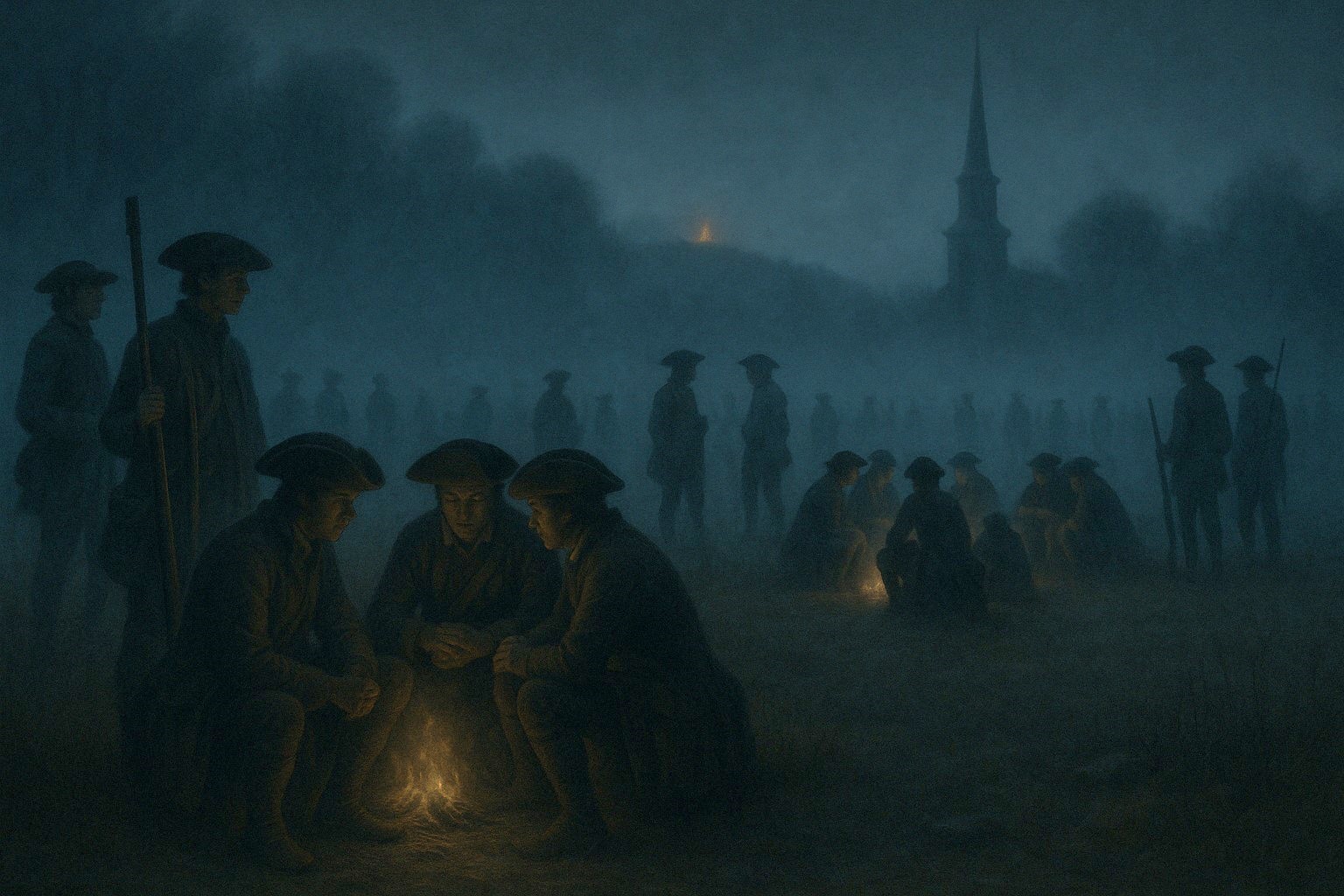
I have long wondered how those men who turned out spent the night of April 19. While the minutemen were well prepared with weapons and ammunition, it’s doubtful they had much in the way of tents or formal shelter. Did Colonel Cotton dismiss them to their homes with orders to return at first light? It’s possible—but seems unlikely. Once dismissed, many might not return. It seems more probable that they encamped somewhere, making use of barns or other buildings.
That night, as darkness settled over the fields and farmyards of Duxbury and Marshfield, men must have gathered around campfires or huddled in barns and meetinghouses. Alarm fires blazed on the hilltops around Plymouth Bay. The minutemen prepared cartridges, checked their flints, cast musket balls from melted pewter, whispered speculations, offered quiet prayers—and waited. One hundred Redcoats with two cannon posed a real threat, but it was the unknown that weighed heaviest: how many Loyalists in Marshfield might turn out, British muskets in hand, emboldened by the King’s soldiers?
All must have wondered as they lay in the dark…What would the morning bring?
[1] David Hackett Fischer, Paul Revere’s Ride (New York: Oxford University Press, 1994), 270.
[2] James Thacher, History of the Town of Plymouth, 2nd ed. (Boston: Marsh, Capen & Lyon, 1835), 211.
[3] William T. Davis, History of the Town of Plymouth: With a Sketch of the Origin and Growth of Separatism (Philadelphia: J.W. Lewis & Co., 1885), 88–89.
[4] Thomas Bradford Drew, “Historical Sketch of Kingston,” in Report of the Proceedings and Exercises at the One Hundred and Fiftieth Anniversary of the Incorporation of the Town of Kingston, Mass., June 27, 1876 (Boston: Rockwell and Churchill, 1876), 58.
[5] Based on a tally of Duxbury men who mustered April 19, 1775 in Commonwealth of Massachusetts, Massachusetts Soldiers and Sailors of the Revolutionary War: A Compilation from the Archives, 17 vols. (Boston: Wright and Potter Printing Co., 1896–1908) as well as an original payroll for Capt. Partridge’s company.

 Historical Digression
Leave a comment