
Daybreak comes with a cool mist hanging over Marshfield’s rivers on April 20th. As the sun climbs, a sequence of three gunshots cracks the morning air, spaced out evenly as a signal. This, followed by the roll of a militia drum. On a hilltop overlooking the countryside, Captain William Thomas of Marshfield (a kinsman of Colonel Anthony Thomas) fires the pre-arranged alarm gun three times while his drummer beats the call to arms. One Marshfield boy, only ten years old at the time, would never forget how Captain Thomas “ascended to the summit of the hill and…discharge[d] the three alarm guns while his attendant beat the drum, which was the concerted signal to acquaint the surrounding inhabitants of the commencement of hostilities”[1]
If the recollection is accurate—that Marshfield’s minute companies withheld signals until April 20—it suggests a shift had occurred on that second day. The mustering of militia was no longer quiet or discreet; it now took place openly, under the watchful eyes of the British garrison and the many Loyalists in town. Capt. William Thomas, and likely his cousin and commanding officer Col. Anthony Thomas, appear to have concluded that the time had come to demonstrate resolve. With additional companies arriving to strengthen the ranks, the moment for action may have seemed imminent.
Had the time come?
Capt. Nesbit Balfour, in command of the British garrison on the Nathaniel Ray Thomas estate must have watched carefully and there are indications that he sent out scouts or spies to determine the strength and disposition of the assembling Patriots.[2] Yet as of the morning of April 20, there was no sign that Balfour intended to make any bold or provocative move. Still, Colonel Anthony Thomas could not afford to assume that would remain the case.
If an attack was to be made that morning, it would have to come from the Patriot side. And so the question still hung heavy in the mist—had the time come? The burden of that decision rested with the senior regimental commander, Colonel Theophilus Cotton of Plymouth, who now stood at a crossroads.
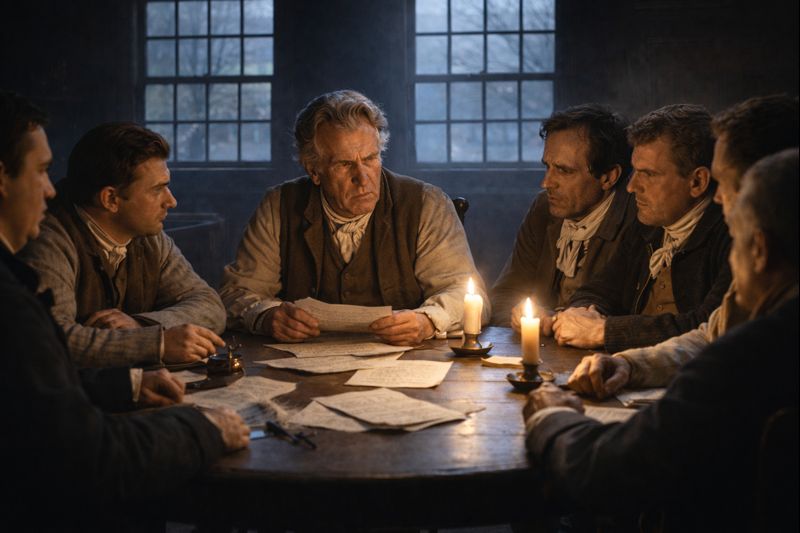
Around dawn that morning, Colonel Theophilus Cotton dismounted outside the Duxbury home of his second-in-command, Lieutenant Colonel Briggs Alden.[3] The house—now preserved as the Alden House Historic Site—still stands, a witness to that moment in history. Inside, Cotton convened a council of war with Alden and, according to multiple sources, Major Ebenezer Sproat of Middleborough.[4] Though still a young man, Sproat would go on to earn distinction for his Revolutionary War service; even then, he was known as one of the most fervent and committed patriots among the officers.[5]
These are the only names of attendees noted in surviving secondary sources—but the full roster of that meeting likely extended beyond what the record preserves. It would be reasonable to assume that some or all of Colonel Cotton’s company commanders were present as well; such participation was standard practice for a regimental council of war. Also among them may have been Lieutenant Judah Alden, the son of Lieutenant Colonel Briggs Alden, who had just completed a punishing ride from Rhode Island on April 19 to defend his home. It also stands to reason that Colonel Anthony Thomas, commander of the 2nd Plymouth County Regiment, might have attended—but perhaps he remained in Marshfield, occupied with the hurried organization of his own command, elements of which were still arriving at his farm that very morning. Coordination between the two Plymouth County regiments would have been essential, especially with hundreds of men converging from opposite directions.
What was said in that room? We can only speculate, but the questions before them must have been urgent and sobering. Should they attack the British position at once, or wait for reinforcements? Were they prepared to engage a British line strengthened with cannons, and possibly Loyalist support? How many men had actually arrived, and how many more were still on the road? Cotton, as the senior officer, would have needed to weigh the risks of provoking a full engagement against the momentum of men eager for action.
And as those officers deliberated, more men were indeed on the move. In towns farther afield—off the main roads or out on the Cape—the alarm had arrived late on April 19. At first light, or shortly after, their companies set out for Marshfield, marching steadily toward what many believed would be the next flashpoint of the conflict. Some had a considerable trek ahead of them.
The town of Middleborough, one of the most populous in Plymouth County in 1775, sent three companies to support the growing Patriot force near Marshfield, numbering about 150 strong. They arrived some time in the latter part of April 20. These included the town’s First Militia Company under Capt. Nathaniel Wood, and the Second and Third companies of Minutemen commanded by Capt. Isaac Wood and Capt. Amos Wade. In addition to the men sent to Marshfield, a fourth company was dispatched north toward Cambridge, where Provincial troops were gathering in the aftermath of the Battles of Lexington and Concord. This dual movement—toward both the local Loyalist garrison in Marshfield and the seat of military activity around Boston—reflects Middleborough’s capacity to mobilize substantial manpower at short notice.
Captain Josiah Hayden’s company of Bridgewater minutemen were also on their way. They rendezvoused with Col. Cotton’s regiment on the evening of April 20, arriving after a full day’s march from the inland town. The company’s presence is also notable for including free men of color, such as Luther Jotham and Elias Sewell, who later served in the Continental Army.[6]
Further south, the Wareham company under the command of Captain Israel Fearing was en route. According to an oft-repeated local tradition, Fearing’s wife—described as a Loyalist—attempted to dissuade him from joining the Patriot effort. As he stepped out the door to lead his men, she reportedly grabbed hold of his coat in protest. Unshaken, Fearing marched on, leaving her behind with a torn piece of fabric in her hands. There is probably some hyperbole here, but the anecdote does underscore the divisions within communities and even families. The Wareham men had a long way to go. It likely took them all day to reach Marshfield, but apparently arrived on the evening of April 20.
Other more nearby companies from Hanover, Plympton, and Scituate got a later start but were organizing on April 20. And further afield, companies from Rochester, Sandwich, Barnstable, and Yarmouth were on their way.
But on the morning of April 20, 1775, Colonel Theophilus Cotton did not know how many men would arrive, and he found himself facing an impossible calculation. He was unaware that the entire countryside was already in motion, and that within another day, more than a thousand militiamen and minutemen from Plymouth and Barnstable Counties would converge on Marshfield. He did not know the condition of the newly arriving companies—were they well-equipped? Well-trained? He likely had only fragments of information and no guarantee that reinforcements would arrive in time—or arrive at all.
So we don’t know what was said during that council of war at the Alden House. But we do know what happened afterward. Colonel Cotton left the meeting and returned to his regiment. And there was no movement that day. His men, many of whom had marched long distances and were still gathering in anticipation of action, must have been restless.
To a modern reader—or even to the more impassioned officers on the scene—Cotton’s caution might seem like hesitation, or even weakness. But it’s important to remember that he had not witnessed the violence of April 19. None of the Plymouth County men had seen the shattered ranks at Lexington, the blood at Concord Bridge, or the carnage and chaos along the road to Menotomy. To them, it was still distant, still surreal—little more than rumor. For Cotton, this was the threshold. Giving the order to attack would not only risk lives; it would mean firing on the King’s soldiers, becoming the face of open rebellion, and unleashing war in their own backyards. It is not unreasonable to think he needed one more day to be certain the moment had truly come.
Meanwhile, in Boston on April 20, General Thomas Gage was grappling with the fallout of the failed Concord expedition and the dawning reality of what would become the Siege of Boston. Even amid this growing crisis, he found time to pen a letter to Admiral Graves, commander of the British fleet in Boston Harbor and Massachusetts Bay. From the content of that letter, it’s clear Gage had just received an urgent communication from Nathaniel Ray Thomas reporting the situation unfolding on the South Shore. We can only wonder how that letter reached Boston.
Gage requested Graves to send a schooner to Marshfield “with all dispatch” explaining that Thomas was “writing to the [Loyal] Inhabitants to come away,” and that Gage intended to order Captain Balfour to withdraw his detachment as well. Graves replied without hesitation, stating that he had ordered the schooner Hope to sail immediately, accompanied by two “wood sloops” to extract both the troops and the local Loyalists.[7]
That night, in Marshfield, Captain Nesbit Balfour and Nathaniel Ray Thomas waited in growing tension. The Thomas estate—once a symbol of Loyalist wealth and comfort—had become a besieged military camp. Balfour and Thomas could only wonder, had their message reached Boston? Would the vessels reach them in time? Or would Cotton give the order to strike before dawn?
The moon rose over the fields of Marshfield, casting a pale light over a town on the precipice.
[1] L. Vernon Briggs, History of Shipbuilding on North River, Plymouth County, Massachusetts, 1640–1872 (Boston: Coburn Brothers, 1889), 277–278.
[2] Justin Winsor, History of the Town of Duxbury, Massachusetts, with Genealogical Registers (Boston: Crosby & Nichols, 1849), 130.
[3] Winsor, 130.
[4] Thomas Weston, History of the Town of Middleboro, Massachusetts (Boston: Houghton, Mifflin and Company, 1906), 323; also Winsor, 130.
[5] Weston, 322-323.
[6] John Hannigan, “Patriots of Color: ‘A Peculiar Beauty and Merit’—Part 4,” National Park Service, last modified February 26, 2021, https://www.nps.gov/articles/000/john-hannigan-patriots-of-color-paper-4.htm.
[7] Thomas Gage to Admiral Samuel Graves, April 20, 1775, and Admiral Samuel Graves to General Thomas Gage, April 20, 1775, in Naval Documents of the American Revolution, vol. 1, American Theatre: Dec. 1, 1774–Sept. 2, 1775; (Washington, D.C.: United States Government Printing Office, 1964; electronically published by American Naval Records Society, Bolton Landing, NY, 2012), 246–247.

 Historical Digression
Leave a comment