
Today marks the 250th anniversary of the Battle of Bunker Hill, fought on June 17, 1775. The battle occurred as part of the British effort to break the Siege of Boston during the early months of the Revolutionary War. In a bold move, New England militiamen occupied the Charlestown Peninsula, aiming to make the British hold on Boston untenable. They entrenched themselves on Breed’s Hill (adjacent to Bunker Hill) in a commanding position overlooking the city.
When approximately 2,200 British regulars under General William Howe launched an assault on the hill, the Americans repelled the first two attacks. However, they were eventually overrun on the third, having run low on ammunition. His Majesty’s forces took the ground—and with it, the Charlestown Peninsula—in a technical victory, but at a staggering cost: over 1,000 British casualties (including a significant number of officers) versus roughly 450 American casualties. It was the highest British casualty rate, by percentage engaged, of the entire war.
In the eyes of the Patriots, Bunker Hill proved that courage and conviction could stand against British military power—a bloody but galvanizing step toward American independence.
Given my own perspective from here on the South Shore, I tend to contemplate the experiences of Plymouth County men during this episode. In the spring of 1775, Colonel Theophilus Cotton of Plymouth commanded the First Plymouth County Regiment. He was an ardent Patriot, known locally for his leadership and zeal. When the Revolutionary War ignited at Lexington and Concord on April 19, 1775, Plymouth County companies mobilized. In my previous articles, I have detailed at length the movement of local militia toward Marshfield, where a detachment of about 100 British Regulars was stationed. Colonel Cotton gathered his regiment and almost led them into battle on April 21. This would have been the second battle of the Revolution…had not the British commander arranged their escape via sloops.
In the following weeks, Colonel Cotton recruited, reorganized, and led his Plymouth County Regiment north to join the main Patriot army besieging Boston. They formally joined the siege operations on May 26, 1775. Records show that by early June, his men were encamped on the Roxbury side of the siege lines on a farm along the coast. Cotton’s regiment was assigned to General John Thomas’s brigade—the right wing (or southern end) of the siege force.
Of the estimated 500 men in Cotton’s regiment, 103 hailed from Plymouth. Thanks to the detailed work of 19th-century historian William T. Davis, we know the names of each of them. The majority—about 65 men—served in the Plymouth company under Capt. Thomas Mayhew, a passionate Patriot and respected town leader.
These men were local farmers, tradesmen, and laborers who answered the call and sustained the long siege. The regiment completed its term of service at the end of 1775, at which point it was disbanded—though some companies were absorbed into other units, and Col. Cotton himself continued to serve.
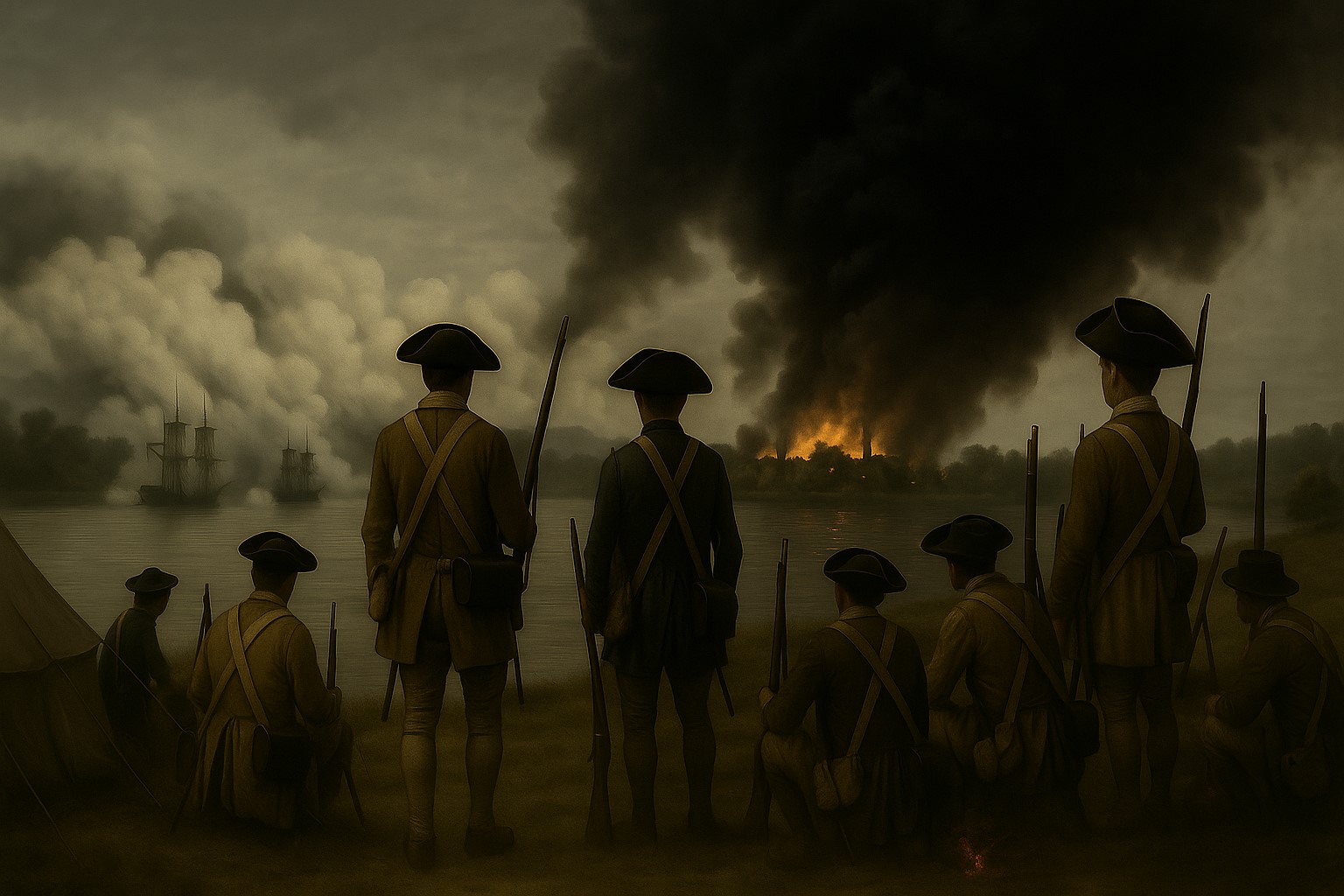
On June 17, 1775, given their position, the Plymouth County Regiment was about as far away from the fighting in Charlestown as any units in the siege could be. So they were not called upon to fight during the Battle of Bunker Hill. They were certainly within sight and sound of the action, and many a Plymouth militiaman must have looked across Back Bay at the huge plumes of black smoke rising from the burning village of Charlestown, and at Breed’s Hill blanketed in the white smoke of gunpowder. They heard the thunder of cannon from His Majesty’s warships and the artillery from Copp’s Hill in Boston, as they shelled the colonial redoubt atop the hill.
But the Plymouth County men would not only be spectators that day. About noon, an alarm was raised in Roxbury. Colonel Cotton’s men, like their comrades in adjacent regiments, rushed to their posts along the earthworks guarding the narrow neck into Boston. General John Thomas, commanding at Roxbury, was ordered to prepare to repel a British sally across Boston Neck. With so much of the Patriot army drawn off towards Charlestown and Cambridge, a second British assault on the southern end of the siege might have gained ground. Plymouth’s militia stood ready with muskets loaded.
As the afternoon passed, Plymouth men, from their defensive positions, must have continued to watch the smoke and flames to the north as houses and churches burned furiously. The thunderous tear of volleys carried across the water. It must have been a jarring symphony of war for farmers and fishermen who, just weeks before, had been living quiet lives in Plymouth.
As evening neared, the British in Boston did make a show of force. Around 6 o’clock, the enemy pulled in their outlying sentries and suddenly opened a heavy cannonade from their fortifications at Boston Neck. The Plymouth troops could do nothing but hug the earth and wait. And many no doubt knew that such an artillery barrage was usually followed by an infantry assault. Across the water, smoldering in smoky twilight, the hills and fields of Charlestown Peninsula had finally gone silent. And in Roxbury, no assault came from Boston Neck.
That night, news slowly filtered down the American lines: the British had taken Charlestown Peninsula but at a fearful price. One can picture Cotton’s Plymouth men around their campfires that night, faces lit by the distant orange glow on the horizon, speaking in hushed tones about the day’s chaos. The Battle of Bunker Hill, seen from afar, taught them what to expect. This is no longer a mere rebellion, they must have realized—this is war.
 Historical Digression