
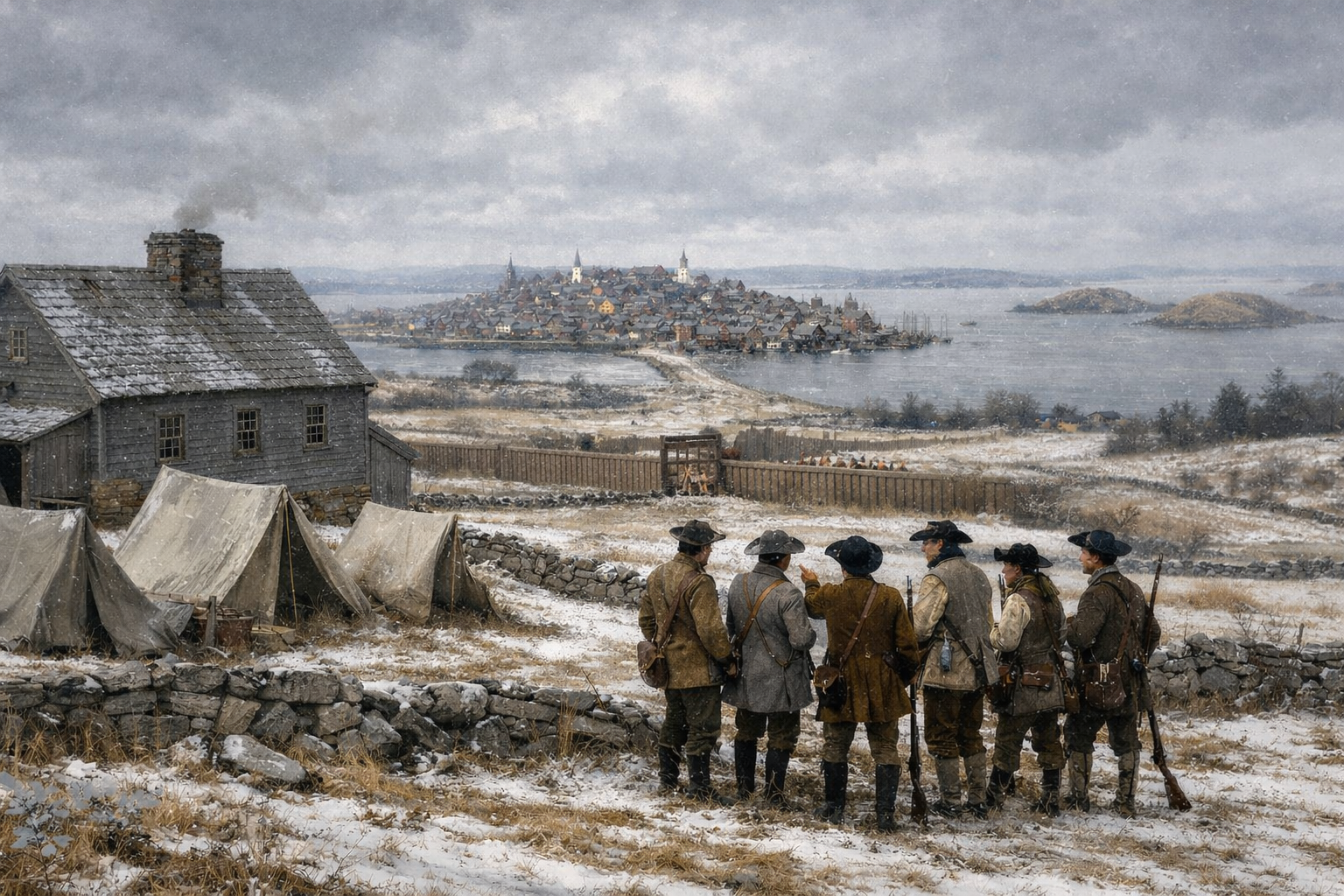
As this year draws to a close, we approach a small but meaningful anniversary. Two hundred and fifty years ago, on December 31, 1775, the First Plymouth County Regiment, commanded by Colonel Theophilus Cotton of Plymouth, disbanded. The men came home from the muddy fields and earthen ramparts of Roxbury, their enlistments complete. Their regiment—one of the first raised after Lexington and Concord—ceased to exist (for the time being, at least).
No grand ceremony marked the moment. No martial music played. These New England farmers, tradesmen, and yes, some enslaved men (a bit more on that in a moment), shouldered their worn packs, turned south toward familiar roads and winter-bare fields, and walked home in small knots of companions. They faded back into the countryside they had come from.
During their months in Roxbury, the men of Cotton’s Plymouth Regiment helped hold the southern line of the Siege of Boston for nearly eight months—long enough to watch a citizen militia gradually reshape itself into an army that was more disciplined, more deliberate, and increasingly permanent. As we approach the anniversary of their disbanding, this feels like a fitting moment to look back at the regiment’s service in 1775.
This closer examination will come in two parts. Part One considers the “where” and the “who”—where exactly the regiment was posted along the siege lines, and who the men were who filled its ranks. Part Two, which will follow shortly, turns to the “what” and the “how,” exploring the duties they performed and what daily life was like for them in Roxbury during that long, uneasy year.
We have already explored how Colonel Cotton mobilized his Plymouth County militia and minutemen in the wake of the Lexington and Concord alarm on April 19, 1775. We have seen how Cotton’s regiment came very close to engaging British troops in Marshfield on April 21, 1775. But after the Marshfield redcoats escaped, Cotton expanded and reorganized his unit, now called upon as a regiment in the Massachusetts Provincial Army.
The Massachusetts Provincial Congress had voted on April 23 to raise 26 infantry regiments for the looming siege of Boston, with enlistments set to expire at the end of 1775. Colonel Cotton’s regiment, called the “First Plymouth County Regiment,” was formally organized in May 1775 under this call. On May 26, 1775, Cotton led his men north to join the main Patriot army investing British-held Boston, officially joining the siege on that date.
After their arrival, Cotton’s regiment encamped on the Roxbury side of the siege lines, which formed the southern sector of the American positions around Boston. Three regimental orderly books kept by Colonel Cotton’s adjutant, Joshua Thomas, survive and based on these, it should be possible to nearly pinpoint where the Plymouth regiment was camped. This author admits that he has only gotten his hands on one of the three books so far—the others will require research trips, but he will attend to them soon.
The first orderly book—recording regimental activities and camp orders from June 22 to July 17, 1775—repeatedly mentions “the Main Guard,” “the Gate,” and “Boston Neck,” pointing unmistakably to the entrance to the Roxbury lines near Boston Neck, the chief control point for anyone moving toward Boston rather than some scattered or distant outpost. It also refers to farm buildings in which most of the regiment was quartered. It mentions sentries posted on “the hill above the mills,” almost certainly the rise overlooking the old Stony Brook mill sites just inland from the Neck. These small mills on Stony Brook are shown on period maps of the siege and provide a good idea of where the regiment was conducting patrols and sentry duty. Stony Brook which emptied into the Back Bay, runs mostly underground now. The mills were located downhill from the old Roxbury Meeting House along Stony Brook in an area once known as “Pierpoint’s Village.”[1]
Taken together, the geography suggests the Plymouth County Regiment spent 1775 right at the throat of the siege, in the cluster of farms and buildings just behind the Roxbury redoubt and gate opposite the Neck, on or beside the main road into Boston. This was probably in the vicinity of today’s Nubian Square (formerly Dudley Square) in Roxbury.
Gen. George Washington assumed command of the New England forces in early July 1775 and soon reorganized the army into brigades. A General Order of July 22, 1775 placed Col. Cotton’s regiment in a brigade under Brigadier General John Thomas (of Kingston), as part of Major General Artemas Ward’s right wing, stationed at Roxbury. General Thomas kept his headquarters in the 1750 Dillaway-Thomas House which, remarkably, still stands in Roxbury.
During the siege, Roxbury, once a quiet, rural village, became a fortified military camp. Most civilian residents loyal to the Crown had fled, and Patriot troops took over buildings for military use, tearing down some for siege line material or firewood. Cotton’s regiment helped build and man extensive earthworks guarding Boston Neck, the only land access to Boston.
Jeremy Belknap, a contemporary observer, described the scene with some horror: the once-busy Roxbury street “occupied only by a picket-guard,” houses abandoned with windows removed and “many shot-holes visible,” and “a wall of earth…carried across the street to Williams’s old house, where there is a formidable fort mounted with cannon.”[2] Such descriptions underscore the regiment’s daily duties: laboring on fortifications, standing guard at redoubts and trenches, and manning the batteries that kept the British bottled up in the city.
Colonel Cotton’s regiment was drawn entirely from Plymouth County, Massachusetts, and numbered roughly 500 officers and men at full strength. The largest contingent came from the town of Plymouth itself, a company of 65 men commanded by Captain Thomas Mayhew and Lieutenant Nathaniel Lewis. An additional 38 Plymouth men served in the regiment’s other companies, making a total of 103 from the Town of Plymouth itself.
It’s a bit tricky to pin down the composition of early Revolutionary War regiments, but extant records show that the following companies were also part of Cotton’s Plymouth regiment at Roxbury: Capt. John Bradford’s Company of Plympton, Capt. Peleg Wadsworth’s Company of Kingston, Capt. Edward Hammond’s Company of Rochester, Capt. Isaac Wood’s Company of Middleborough, Capt. Amos Wade’s Company of Middleborough, Capt. Samuel Bradford’s Company of Duxbury, and Capt. William Shaw’s Company of Bridgewater and Middleborough. There were likely others. And not all of these companies served the full eight months that Cotton’s regiment was stationed in Roxbury, some came and went with shorter terms of service.
Among the rank and file, there were likely some Black soldiers from Plymouth. This matter too, it difficult to pinpoint as enlistment records, especially for these marginalized men, were sometimes vague. We know of many Black and Native soldiers who served from Plymouth over the course of the war. Lt. Col. Nathaniel Goodwin’s Revolutionary War recruiting book for Plymouth County (1776–1781), preserved at Pilgrim Hall Museum, lists men explicitly marked “Negro,” “Black,” “Mulatto,” or “Indian,” including several attached to “Col. Theo. Cotton’s regiment.” The overall service of these men will be the focus of a future post. The difficult part is determining which of them were present at this early stage in Cotton’s regiment in 1775 (as opposed to one of the later iterations of Cotton’s regiment in 1777 and 1781). At least 10 Black and Native men served under Cotton at some point in the war. More research is needed, but at this time it seems most of them enlisted in 1777 and so were not present in 1775–at least not with Cotton’s regiment.[3]
One Black soldier who may well have been there was Quamany Quash, who enlisted while enslaved to Colonel Theophilus Cotton and likely served under his command during the siege — before later fighting in the Continental Line. Cotton apparently agreed to “give” Quash his freedom if he served for three years in the Continental Army. After his service, Cotton delayed and did not draw up manumission papers until Quash turned 21 in 1781. By this time the institution of slavery was being dismantled in Massachusetts. Nonetheless, Cotton could legally retain half of Quash’s army wages, though Cotton allowed him to keep the full sum of Quash’s bounty for enlisting.[4]
The regiment’s officers were the county’s Patriot elite. Col. Theophilus Cotton of Plymouth led a cadre of captains and field officers drawn from the most influential families of Plymouth County. Their commissions were back-dated to May 19, 1775—the formal start of Massachusetts’ wartime army—and most of their men enlisted through the end of the year, December 31. The regiment’s numbers rose and fell as recruits trickled in, men went sick, or took furloughs, but Cotton’s command remained a steady—and very visible—presence on the Roxbury lines throughout 1775.
So there they were: Plymouth County farmers, tradesmen, apprentices, at least one enslaved man, and possibly a small number of free Black men, all thrown together in a regiment that found itself posted at a pivotal position of the siege. We now know where they stood and who they were. But what was it actually like to serve there? What did these men do day after day on the Roxbury lines — and what moments of danger, boredom, discipline, humor, fear, and resolve filled those eight long months? In Part Two, we’ll step inside the regiment’s orderly books and the surviving accounts to follow Cotton’s men through the rhythms — and occasional shocks — of life on the siege lines.
[1] Joshua Thomas, Massachusetts Regimental Orderly Book (orderly book, 16 July 1761–21 July 1775, last 8.5 pages concerning Roxbury and the Siege of Boston, 1775), GLC02663, The Gilder Lehrman Institute of American History, New York.
[2] Jeremy Belknap, Journal of My Tour to the Camp (diary entry, fall 1775), in Collections of the Massachusetts Historical Society, 1st ser., vol. 4 (Boston: Massachusetts Historical Society, 1858–1860).
[3] “Col. Theophilus Cotton,” Boston 400: Celebrating the 400th Anniversary of Boston (blog), accessed December 25, 2025, https://boston400.org/theophilus-cotton-revolutionary-war/; Jeremy Bangs, “Black & Native American Patriots of Plymouth,” PDF, Pilgrim Hall Museum, accessed December 25, 2025, https://www.pilgrimhall.org/pdf/Black_Native_American_Patriots_Plymouth.pdf
[4] Pilgrim Hall Museum, “Long Road to Freedom: African-Americans in the Old Colony,” accessed December 25, 2025, https://www.pilgrimhall.org/long_road_to_freedom.htm

 Historical Digression
Leave a comment