
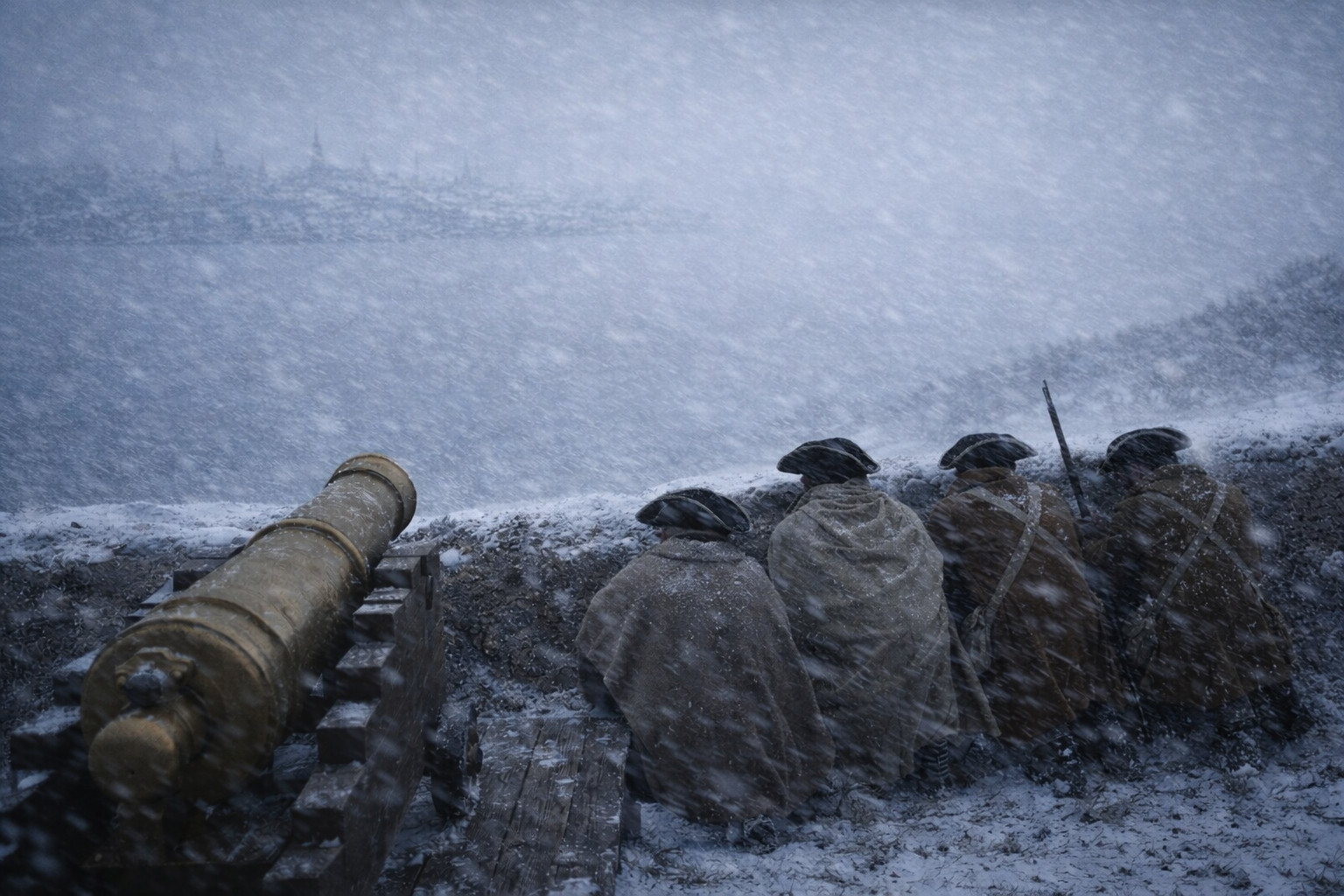
We resume following young James Thacher, a Surgeon’s Mate in the Continental Army, as he took part in the occupation of Dorchester Heights on March 5, 1776. I should note that Thacher’s journal is one of the best sources on this historic military maneuver and a good deal of what we know about it is thanks to him. As his entry for this momentous day is rather lengthy, I will largely let him speak for himself, with just a few comments interjected…
At about four o’clock our regiment followed to the heights of Dorchester, as a relief party. On passing Dorchester Neck I observed a vast number of large bundles of screwed hay, arranged in a line next the enemy, to protect our troops from a raking fire, to which we should have been greatly exposed, while passing and repassing.
Thacher is here referring to the fact that the whole operation had to pass relatively close to the British fortifications on Boston Neck. To screen the mass movement, provincials built a wall of hay bales along the route. It is difficult to believe that such a ruse did not seem suspicious to the British, and yet, the whole maneuver proceeded unchallenged.
The carts were still in motion with materials ; some of them have made three or four trips. On the heights we found two forts in considerable forwardness, and sufficient for a defence against small arms and grape shot. The amount of labor performed during the night, considering the earth is frozen eighteen inches deep, is almost incredible. The enemy having discovered our works in the morning, commenced a tremendous cannonade from the forts in Boston, and from their shipping in the harbor. Cannon shot are continually rolling and rebounding over the hill ; and it is astonishing to observe how little our soldiers are terrified by them. During the forenoon we were in momentary expectation of witnessing an awful scene ; nothing less than the carnage of Breed’s hill battle was expected. The royal troops are perceived to be in motion, as if embarking to pass the harbor, and land on Dorchester shore, to attack our works. The hills and elevations in this vicinity are covered with spectators to witness deeds of horror in the expected conflict. His Excellency General Washington is present, animating and encouraging the soldiers, and they in return manifest their joy, and express a warm desire for the approach of the enemy ; each man knows his place, and is resolute to execute his duty.
In the clear light of morning, upon seeing the works erected on the heights, British General Howe observed in Boston with absolute shock that the Americans had accomplished in one night what would have taken his troops months. He also wrote officials in England that the work must have required 15,000 to 20,000 men. In fact, it had been about 2,000. Howe refused to let all this go unchallenged. He prepared to assault Dorchester Heights, just as British forces had assaulted Breed’s Hill in Charlestown the year before when Americans occupied those heights. Redcoats began moving by boat for what appeared would be large attack.
Our breast works are strengthened, and among the means of defence are a great number of barrels, filled with stones and sand, arranged in front of our works; which are to be put in motion and made to roll down the hill, to break the ranks and legs of the assailants as they advance. These are the preparations for blood and slaughter! Gracious God! if it be determined in thy Providence that thousands of our fellow creatures shall this day be slain, let thy wrath be appeased, and in mercy grant, that victory be on the side of our suffering, bleeding, country.
The attack never came, largely because, as Thacher mentions in the next passage, the weather turned extreme. A massive nor’easter bore down on Boston just as the British attack began to organize…
The anxious day has closed, and the enemy has failed to molest us. From appearances, however, there are strong reasons to suppose, that they have only postponed their meditated work till another day. It is presumed that the martial fire, which has been enkindled in the breasts of our soldiery, will not be extinguished during the night, and that they will not rest quietly under their disappointment. Early in the morning of the 6th, our regiment was relieved from its tour of duty, and I bade adieu to Dorchester heights, without being called to dress a single wound. Not more than two or three men were killed or wounded during the twenty four hours. Some of the British troops were seen to embark, and pass down towards the castle last evening [Castle William, the island fort in Boston Harbor], to be in readiness, it was supposed, in conjunction with others, to attack our works this morning; but a most violent storm came on in the night, and still continuing, obliges General Howe to abandon his enterprise, and thus has a kind Providence seen fit to frustrate a design, which must have been attended with immense slaughter and blood shed. General Howe must now be sensible of his exposed situation, and be convinced of the immediate necessity of evacuating the town of Boston, if he would prevent the sacrifice of his fleet and army.
It was apparent to Thacher, and it seemed apparent to nearly all. With this victorious maneuver by the Continentals, the British would have to quit Boston.

 Historical Digression
March 6th, 2026 at 5:06 am
great description and vivid re-creation of the scene. The real reason digression captures my attention and imagination each time I have a chance to read it. Please don’t stop educating and recreating scenes like this for interested Americans. The trails and tribulations of our forefathers and the respect they deserve for their bravery and strength should never be forgotten.
March 6th, 2026 at 3:09 pm
Thank you! Nice to know this stuff resonates with people. Hope you keep reading.