

We might imagine a farmer repairing his rail fence on January 23, 1775, 250 years ago this week. Bare branches of trees standing against a bright blue sky. It’s cold, but the winter on the whole has been milder than usual. The roads muddier. Our farmer perhaps pauses mid-step, dragging a wooden rail, when he hears it. An out of place noise, unexpected but unmistakable. Drums. A crisp military cadence.
He turns to see something at first curious, then increasingly alarming. One of the King’s soldiers in a scarlet and black coat, a sword in his hand, marching up over the rise in the road. Beside him, a crew of men, also in red coats, dragging an artillery piece. The groan of the gun carriage’s wheels and the drums are the only sound. Until the column of men draws closer and the tramp of their boots on the frozen ruts of mud becomes a low rumble. File upon file of them, sunlight glinting off polished brass and steel. They were from a world entirely unlike the one the farmer knew. He had never seen a Redcoat in his life, yet from the talk in town lately, he knows exactly what he is looking at. They represent power, discipline, and danger.
The farmer watches as they pass. Perhaps his family comes to the roadside to silently watch with him. They wonder what it will all mean as the soldiers march towards the Meeting House in Marshfield.
Nothing like this had ever been seen on the South Shore of Massachusetts. That day, 250 years ago, Marshfield became the only town outside of Boston to be occupied by a detachment of the King’s troops. More peculiar still, the inhabitants of the town (or a large portion of them at any rate) had actually requested the presence of the Redcoats.
We don’t know how the inhabitants reacted that day. We do know they were deeply divided, roughly half of them Loyalists (far more than in other surrounding towns) and the other half identifying with what had come to be known as the Whig or Patriot cause.[1] Perhaps some of the Loyalists made a modest show of welcoming the soldiers, uttering hushed greetings. For the Loyalists, the Redcoats represented safety and order. Others, meanwhile, must have watched silently from doorways. And surely there were some who watched from afar, their faces hard with contempt. Having no illusions about the purpose of this show of force, they grew more determined to resist.
As the column approached the center of town, they passed Tea Rock Hill. Though little more than a modest rise, it loomed large in the memory of Marshfield’s inhabitants. Indeed, the trouble that took place there just over a year ago had led to all this. On December 19, 1773, three days after Bostonians dumped the East India Company’s tea in Boston Harbor, the patriots of Marshfield followed suit.
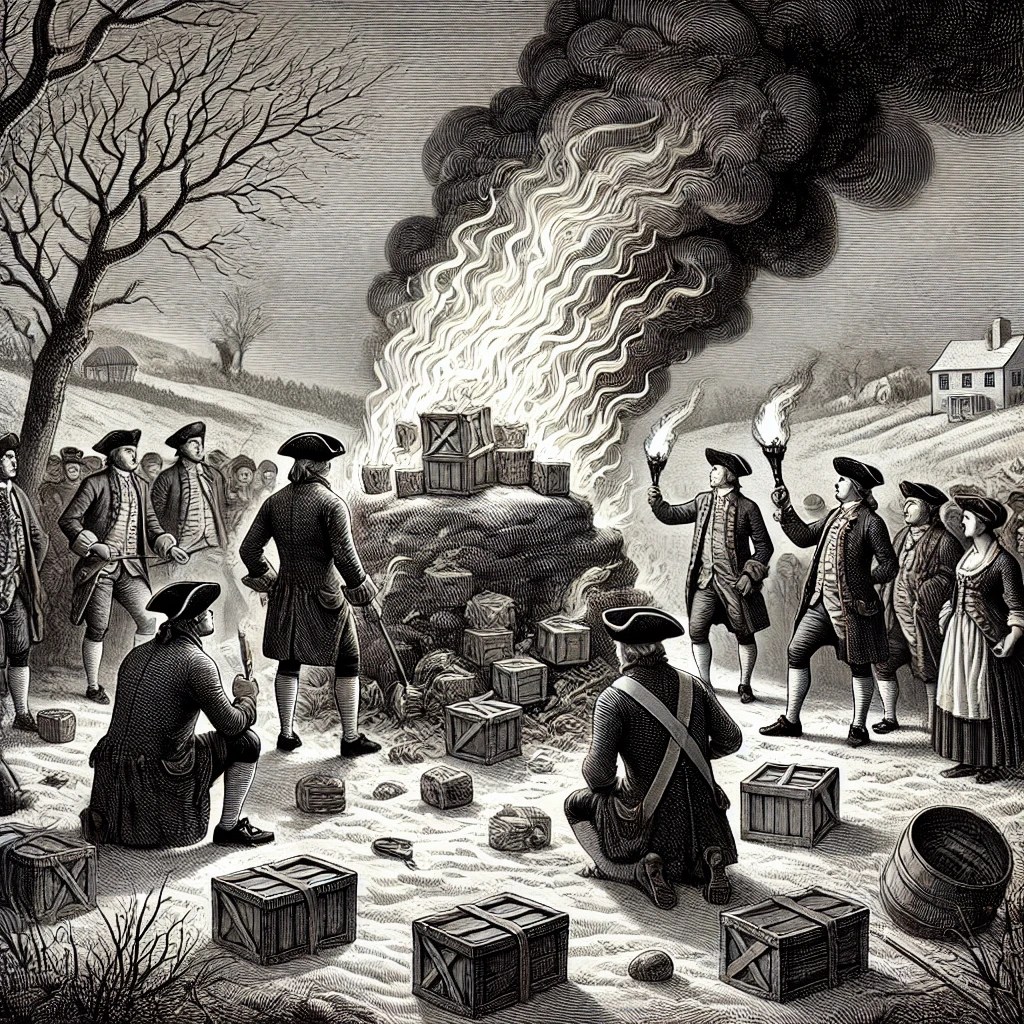
Led by Jeremiah Low and Benjamin White, Marshfield’s Patriots broke into the Old Ordinary near the town common. They hauled out crates of tea that had been stored there by Loyalists. They piled it on a ox cart together with tea confiscated from other locations in town. They proceeded to the top of a rocky hill overlooking the Meeting House and heaped the crates onto a boulder. Jeremiah Low stepped forward, a torch in hand. After a brief prayer, he set the heap ablaze. The boulder, scorched and blackened, became known as Tea Rock, a quiet sentinel of defiance.[2]
Marshfield’s unusually high concentration of Loyalists set it apart sharply from its neighboring towns. Exactly how there came to be so many Loyalists in that town is not entirely clear but a Marshfield historian has advanced a plausible theory.[3] The pattern of land grants in Marshfield, going back to the 17th century, tended to result in very large estates and eventually a large gentry class, whose wealth and influence permeated the town’s politics. At the center of this Loyalist faction stood Nathaniel Ray Thomas—a man of great wealth, sharp ambition, and a penchant for dominance.
Nathaniel Ray Thomas was the embodiment of Loyalist aristocracy in Marshfield, and he cast a long shadow over the town. Thomas wielded both economic and political power and played a leading role in shaping Marshfield into a Tory stronghold. His imposing estate, now the site of the Daniel Webster House, symbolized his status. To his supporters, he was a stalwart defender of order; to his enemies, the very image of oppression.
It is no coincidence that the Redcoats in Marshfield chose the Nathaniel Ray Thomas estate as their camp. In doing so, they were not merely safeguarding the town’s Loyalists but effectively serving as a 100-man bodyguard to Thomas himself, the Crown’s most prominent and embattled ally in the region. How did it come to this?
In the wake of Marshfield’s Tea Party, Thomas issued a call in January 1774 (a year before the Redcoats arrived) for a Town Meeting to address the outrageous acts of those who defied the King’s authority. At this meeting, he presented resolutions declaring Marshfield’s loyalty and obedience to King George III, condemning the intimidation of Loyalists in Plymouth, and appointing Abijah White, a prominent Marshfield Loyalist, to conduct an investigation into the Tea Rock incident “that the perpetrators of those mischiefs may be detected and brought to justice.”[4]
These resolutions put Marshfield on a path that would bring Patriots and Loyalists to the very brink of open warfare on the South Shore. Exactly how things got that bad, and exactly how they were eventually resolved, will be the subject of future posts recognizing this 250th anniversary of the Revolution on the South Shore.
[1] In Lloyd Vernon Briggs, History of Shipbuilding on North River, (1889), pp. 275-276, Briggs includes a reprint of a 1774 article in the Massachusetts Spy informing us that the town vote on the resolves regarding the Marshfield Tea Party and other acts of defiance passed by one vote. This would suggest an even split between Loyalists and Whigs—at least at that meeting.
[2] Marcia Abiah Thomas, Memorials of Marshfield and Guide Book to its Localities at Green Harbor (Boston: Dutton and Wentworth, 1854), 72; Lysander S. Richards, History of Marshfield, volume 1 (Plymouth, MA: The Memorial Press, 1901), 188.
[3] Cynthia Hagar Krussell, Of Tea and Tories (Marshfield: Marshfield Centennial Committee, 1976)
[4] Richards, 103.
 Historical Digression