
Tag Archives: History

Part Three: The Demise of Plymouth’s Whaling Fleet

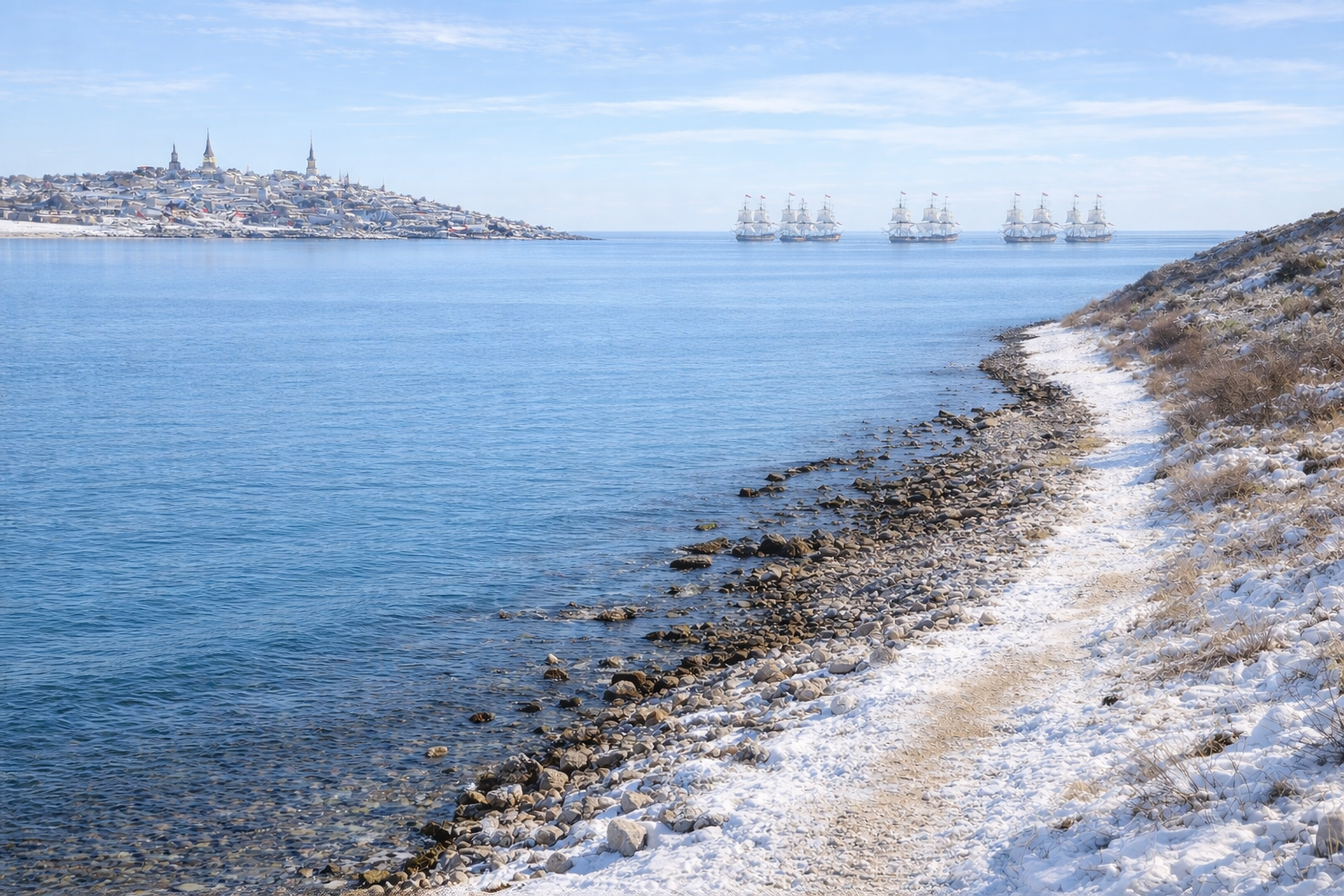
Imagining the scuttling of Plymouth’s most successful whale ship, the Fortune. (AI image based on an engraving of the sinking of the “Stone Fleet,” of which the Fortune was a part, in Harper’s Weekly, January 13, 1862)

In the 1830s, Plymouth’s whaling fleet reached its zenith. From James Bartlett’s original ventures, the town’s merchants and tradesmen had expanded the undertaking into a respectable flotilla, owned by shifting syndicates and captained by a mix of Nantucket veterans and ambitious locals.

In the early 1830s Plymouth was still adding large whalers to its fleet. The Triton (314 tons), built at Durham, New Hampshire in 1833, endured a punishing cycle of Pacific voyages before being sold off to New Bedford in 1846. Two years later Bartlett and a large syndicate acquired the Mary and Martha (316 tons) from Westbrook, Maine, but she managed only two Plymouth voyages before also being sold to New Bedford in 1846, later ending her days condemned in Buenos Aires.

Smaller vessels, too, filled out Plymouth’s roster. The Yeoman, built locally in 1833, made several South Atlantic cruises under Captains Gooding and Clark. The brig James Monroe, owned in part by Isaac Hedge, hunted near the Cape Verde Islands and Caribbean under Captains Simeon Dike and Nathan Strickland. Schooners like the Exchange, Maracaibo, Mercury, and Vesper also tried their luck on shorter cruises, ranging from the Caribbean to the Azores. These smaller craft, seldom more than 100 tons, were meant to keep profits flowing between the years-long Pacific voyages of the larger ships.

By the late 1830s, Plymouth could boast a dozen vessels in its whaling fleet. Over roughly 25 years, they completed around sixty voyages, delivering more than 27,000 barrels of sperm oil, 14,000 barrels of other whale oil, and untold quantities of baleen. For a town long overshadowed by Nantucket and New Bedford, it was a respectable achievement.

The records suggest that the high-water mark of Plymouth’s whaling enterprise came in the early 1840s. The busiest year in terms of departures was 1841, when no fewer than seven vessels cleared the harbor for waters both near and far. Almost all of them sailed in the summer months, and it must have been a lively, crowded season on the waterfront.

In terms of profits, 1838 was the banner year. Only two vessels returned that year, but one was the Arbella, heavy-laden with 2,300 barrels of oil. With the addition of the Triton’s smaller return, the total rose to 2,800 barrels, the richest single year’s return Plymouth would see. A close second came in 1842, when seven arrivals together yielded 2,614 barrels. The town’s whaling trade seemed both busy and profitable.[1]

But that moment of promise was short-lived. What followed in the mid-1840s was a rapid and uncanny decline, a series of calamities that would extinguish Plymouth’s whaling venture within a few short years.

The year 1843 opened the ledger of disasters. That summer, the Mercury, the smallest schooner in the fleet, capsized outright and went down, vanishing beneath the sea. Only months later, another whaler, the schooner Exchange, was caught in a violent gale. Her masts were torn away and she lost nearly all her cargo, including a whale that had been secured alongside—all swept into the waves. In the same year, another Plymouth vessel, the brig James Monroe, was condemned in Bahia, Brazil. Her cargo of whale oil was shipped home on another vessel. It’s unclear how her crew made it back, stranded four thousand miles from home. A fourth ship, the brig Yeoman was quietly sold off to New Bedford in 1843. In all, it proved to be a year of reversals for Plymouth’s fleet and it must have struck the town with a jolt.[2]

Even when no longer in Plymouth’s control, her vessels still seemed touched by misfortune. The Triton while hunting the distant waters of the South Pacific in 1847 under New Bedford owners stopped at Sydenham’s Island, known to its people as Nonouti, a low coral atoll in the southern Gilbert Islands. The sudden surge in the Pacific whale fishery in the 1830s led to hundreds of New England vessels stopping at this once isolated place. With so many intrusions came friction—misunderstandings over trade, suspicions of theft, and especially crew desertions that soured relations. What followed at Nonouti was not unique, but part of a wider pattern seen from the Gilberts to the Solomons, where wary island communities sometimes turned violent against foreign ships that pressed too close.

While the captain of the Triton and some of the crew were ashore bargaining for a fluke chain, the natives swarmed the ship, killing a mate and several of the crew. The second mate and his boat’s crew managed to escape, rowing desperately out to sea. Other whaleships in the area—the United States and the Alabama, both of Nantucket—touched at Sydenham’s soon after and helped rescue the surviving crew (including the captain who were held captive) and recovered the Triton which had drifted offshore. In all, five men were killed and seven wounded.[3]

In 1844 the Fortune—Plymouth’s “greasiest” ship—was sold off to New Bedford. She would sail on for many years under new owners, but her loss represented an acceleration of the decline of Plymouth’s fleet. To part with their most successful vessel was symbolic enough; yet more ominous still was the strange destiny that awaited her…more on that in a moment.

Then in July 1845 came the blow that struck closest to home. James Bartlett, Jr.—the founder of Plymouth’s whaling enterprise, the man who had carried it through nearly twenty-five years—died at the age of fifty-nine. The cause of his death was recorded as “angina pectoris,” a heart ailment we would now recognize as coronary disease, likely leading to sudden cardiac arrest. For a man who had staked his fortune and reputation on this precarious industry, the strain of its unraveling must have weighed heavily. With Bartlett gone, Plymouth lost not only its pioneer but its most capable leader.

The following year, 1846, brought further tragedy. The schooner Maracaibo was wrecked, a total loss. In the storm that claimed her, the second mate and two crewmen were washed overboard and drowned. In 1847 another Plymouth whaler, the Exchange, ran hard aground on the island of Margarita, off the coast of Venezuela.

By 1849, what ships had not been wrecked or condemned were sold off, most to New Bedford, whose deeper harbor and stronger commercial networks made it the inevitable inheritor of Plymouth’s hopes. The experiment that had begun in such optimism in 1821 ended rapidly, its fleet scattered or destroyed.

There was never any talk in Plymouth of a curse upon its whalers. No tavern tales, no whispered superstitions—that I know of. Yet looking at the string of misfortunes, I am almost surprised that such a story was never told. For if any whaling fleet ever seemed to sail under an evil star, it was Plymouth’s. In little more than four years, from 1843 to 1847, disaster overtook nearly every vessel.

In an eerie epilogue, Plymouth’s luckiest whaler met an unusual fate, sacrificed in a bizarre stratagem of war. Long since sold to New Bedford, the Fortune was among the old whaleships purchased by the U.S. Navy during the Civil War, filled with stone, and scuttled as obstructions in Charleston Harbor—the Union’s so-called “Stone Fleet.” Observers found the spectacle mournful. Herman Melville wrote of those hulks with an almost personal pity: “I have a feeling for those ships, each worn and ancient one…They sunk so slow, they died so hard…their ghosts in gales repeat, ‘Woe’s us, Stone Fleet!”[4] The plan itself proved folly; currents opened new channels and blockade-runners slipped past the barriers. And there, among them, went the Fortune, formerly of Plymouth, ending her long career as a heap of ballast on the harbor floor.

Thus ended a twenty-five year experiment—ambitious, and ultimately tragic. Plymouth’s whaling fleet, once a symbol of promise and pride, slipped beneath the water, leaving behind only scattered records and faint memories.


[1] Data on Plymouth’s whaling returns is taken from Alexander Starbuck, History of the American Whale Fishery from Its Earliest Inception to the Year 1876 (Waltham, MA: Published by the Author, 1878).

[2] Starbuck, 393.

[3] Starbuck, 131.

[4] Herman Melville, The Stone Fleet: An Old Sailor’s Lament, from Battle-Pieces and Aspects of the War (New York: Harper & Brothers, 1866), 31.