
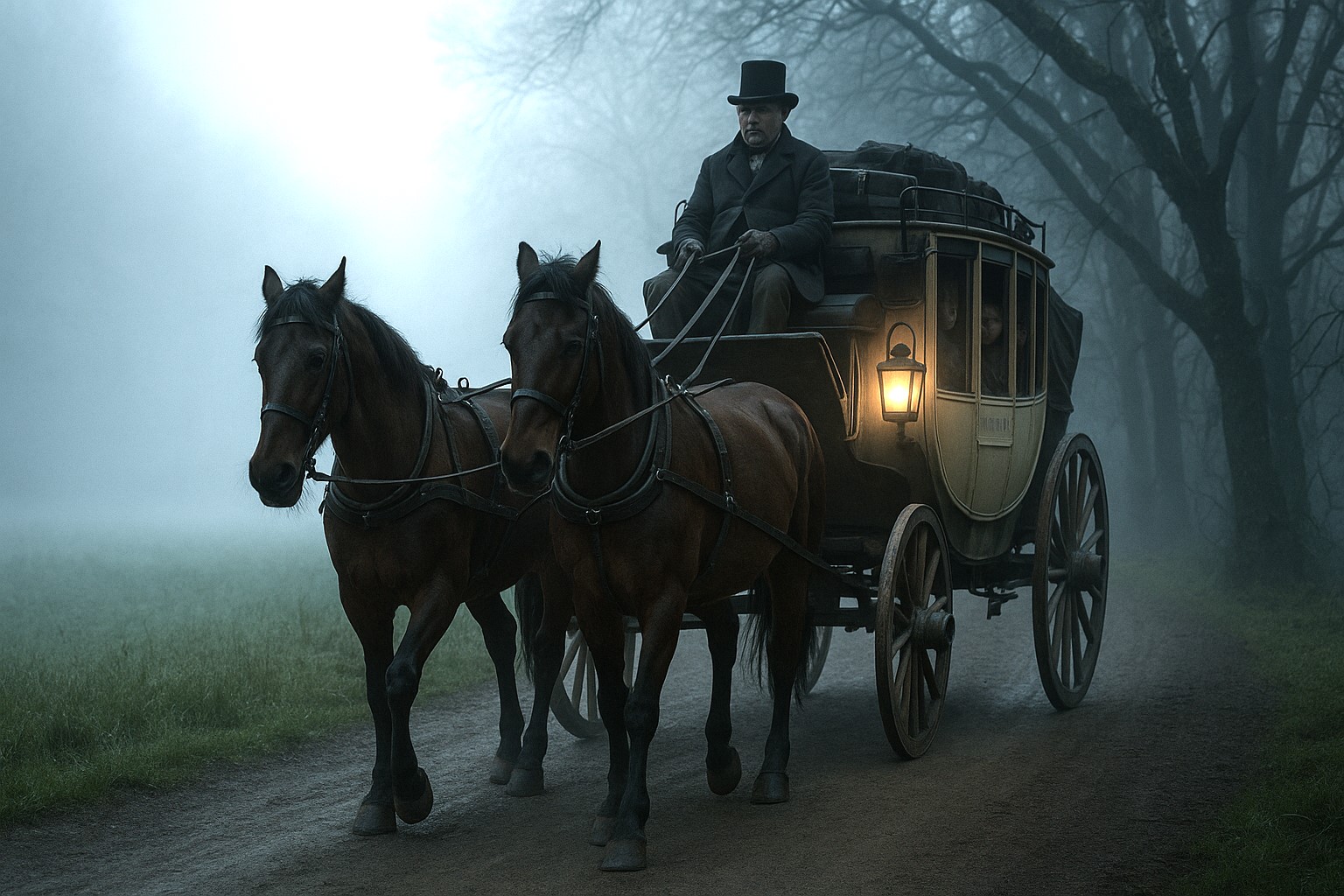
The coach jolted and swayed as it passed along the deeply rutted road, pulled by a pair of weary horses moving at a slow walk. Their journey to Plymouth was nearly done. Having been waylaid changing horses in Hingham, they were now losing the sun. On one side of the road, bare branches caught the last, cold light of the waning day. On the other side stretched a wide open meadow shrouded in thick mist, growing darker by the moment.
Within the coach, despite the late autumn chill, the air was close and filled with the smell of leather and damp wool. Three passengers—strangers—rode in silence. A stout merchant leaned toward the window, eyes darting into the gloom as if searching for something just beyond sight. Next to him sat a young attorney with an open notebook balanced on his knees, busily writing with a dull pencil. Across from them sat a well-dressed elderly man with a full head of white hair and sharp eyes. His gloved hands rested firmly on the brass knob of a walking stick, its shaft planted squarely on the floorboards between his boots.
The merchant broke the silence, his voice hushed. “I mislike this stretch we’re coming to. I wish the driver would move us along better. I’d soon as not be passing it by moonlight.”
The attorney looked up from his notebook, “Now why is that, my friend?”
The merchant straightened, “They call this meadow here the Devil’s Acre. Travelers hear the most awful cries, coming from the ditches yonder. And more than one man has seen shapes cross the road here after dark, white as winding-sheets.”
A corner of the attorney’s mouth lifted in a slight smirk. “You jest.”
The merchant shook his head. “Not from Plymouth, are you?”
“Boston,” the attorney said flatly.
“If you were, you’d know.”
They returned to silence. The doctor simply stared out into the deepening dusk. At length, he made only a short, dismissive grunt.
The attorney looked up from his notebook. “You said something, sir?”
“I did not,” the doctor replied.
The merchant frowned, “But you made a noise just now.”
“A sound, yes,” said the doctor evenly. “Which is quite a different thing than having something to say.”
The attorney snapped his notebook shut, his expression brightening with recognition. “Sir…yes, I believe I know you now. I have been trying to place you. You are Doctor James Thacher. I heard you speak at the Boston Athenaeum on your service in the Revolution.”[1]
Thacher inclined his head. “Perhaps you did.”
“And more recently,” the attorney pressed, “on your researches into the occult. Quite extensive, if I recall. You even said you were preparing a book—on demons, apparitions, and the like.”
The merchant turned wide-eyed toward his fellow passenger. Thacher gave only the faintest hum, a sound that was neither denial nor affirmation.
The attorney leaned back with a hint of mischief in his voice. “Well then, Doctor, given your expertise…you must have some opinion on ‘yonder’ meadow our companion speaks of. Tell us plainly—is it haunted?”
Thacher’s lips pressed into a thin line. “First, my good sir, my essay is not about demons and apparitions, but about the human frame itself—the nervous system, its infirmities, and the way imagination and disorder can conjure phantoms as vivid as reality. That is the true subject. And second—the meadow is not haunted, for there is no such thing as a haunted place, save in the credulous mind of man.”
“All the same,” the attorney persisted, “we would value your counsel. My companion here trembles at phantoms…”
“Here now…” the merchant began.
The attorney went on, “And I confess I am undecided in my own mind. You have studied the lore of apparitions as carefully as any man in New England. Will you not speak to it?”
At this, Thacher’s gaze grew grave and penetrating. His voice, when it came, was steady and measured, “Very well. Sir, such tales of wandering spirits are the spawn of ignorance. They are torments born of disordered health, of imaginations over-stimulated. A weary or intemperate mind might perceive a touch upon the arm that no hand delivers, or behold a form where there is only mist…”
The merchant coughed. “Ignorance? Sir, I don’t take kindly to…”
Thacher did not so much as glance at him but pressed on, his words quickening, his voice growing more animated. “Consider the case of a young lady who, after attending the funeral of a friend, awoke to see in her chamber the very likeness of the departed—face, form, even the marks of disease. She cried out in terror that her friend stood before her. Yet when the lantern was brought, what did they find? A robe and cap hung on a chair. Tell me, was that a messenger from heaven—or merely grief and fancy at their cruel work?”
The attorney had re-opened his notebook and scribbled notes quickly. The merchant frowned and answered, “Perhaps. Yet there are other tales not so easily explained. Deaths foretold. Visions fulfilled to the very hour.”
The attorney leaned in eagerly. “Indeed, Doctor, was there not a Lord Lyttleton who was visited in a dream…by his deceased mother, if I recall, foretelling that he should die in three days. And die he did, to the very hour. How would you explain such a case?”
Thacher’s eyes seemed to spark in the dim light. “Ah, yes. Lyttleton, a man of wit undone by dissipation. It is true he declared his mother’s spirit foretold his death. On the appointed night he retired early, feigned mirth, and mocked the prophecy. Yet as the clock struck midnight, he was found dead in his bed. A marvel? Not so. The man was worn to ruin by excess, weakened in body and spirit alike by the weight of his vices. After the dream, fear gnawed at him. Each hour, as the fatal moment approached, his agitation grew, until his feeble frame gave way. He did not die because a ghost foretold it, rather it was an illusion born of a guilty conscience that drove him to death.”[2]
Thacher shifted. “Here now. Consider a case of a hundred years ago, as recorded by Reverend Ruggles of Rochester, who wrote of a boy tormented by extraordinary convulsions. His parents swore he was bewitched by a neighbor, a certain widow woman. They told of how he saw her specter enter his chamber though the doors were barred. How he arched backward in agony until the crown of his head and the soles of his feet met together, while two or three strong men could not restrain him.”
“Merciful heaven…” the merchant breathed.
“To their eyes,” Thacher said, “nothing short of witchcraft could suffice.”
The attorney paused in his scribbling. “And was it not so?”
Thacher rapped his cane sharply against the floorboard. “It was not. Reverend Ruggles examined the case and found no Devil there. The boy’s body was wasted to a skeleton, his brain disordered. A botched course of physic—a salivation begun with mercury, then abandoned—had poisoned his frame and left his nerves in torment. His contortions, violent though they appeared, were the fruit of disease and mistreatment, not of sorcery. When the disorder was properly treated, the convulsions ceased, his health returned, the witchcraft vanished like smoke, and the poor widow was exonerated.”[3]
The attorney looked up again. His eyes shone in the lantern’s glow. “Doctor, I must ask. You have cataloged these stories. Written whole chapters upon them. You speak of their causes with authority. Forgive my frankness, but why give them such attention if you consider them folly?”
For the first time, Thacher hesitated. His gaze drifted to the window, to the road now swallowed in darkness. The rhythm of the horses’ hooves beat a steady measure. “Because,” he said at last, his voice lower, “error must be studied if it is to be refuted. And more than that—to peer into these tales is to peer into the strange depths of our own nature. The study of man’s illusions may reveal more of his soul than the study of his truths. There is mystery enough in that, sir. Mystery enough to command my pen and thought. I do not believe in phantoms that stalk the night, yet the phantoms within us…” He trailed off.
The merchant crossed himself, muttering, and pressed back into the bench as the coach rattled on.
The young attorney regarded the doctor for a long moment, the faint smile still on his lips. At last, he leaned forward. “Sir, I am to be in Plymouth for a week on a court case and shall lodge at Mr. Wright’s Hotel. Might I beg the honor of your company at dinner one evening? I should greatly value the chance to pursue this conversation further.”
Thacher’s sharp eyes softened only slightly. “You may beg it, sir,” he said, “but whether you will have it is another matter. We have yet to escape our companion’s haunted wood.” For the first time, Thacher smiled. “If Providence should allow our safe arrival, I will not refuse the prospect of good company.”
The attorney nodded and sat back. Thacher, meanwhile gazed out the window. As the attorney watched, a shadow of concern seemed to slowly pass across Thacher’s face. Whether it was stirred by something he spied in the gloom or by some darker memory rising, the attorney could not tell.
[1] The reader will, I’m sure, have deduced by this point that this scene is mere fiction. And yet, Dr. James Thacher (1754-1844) was a very real person. A Continental Army surgeon during the American Revolution, he went on to become one of Plymouth’s most respected physicians, authors, and historians. After a long medical career, he devoted his later years to the preservation of history…and also studied superstition and the occult. While reading his fascinating book on the latter subject, it occurred to me…What would it be like to meet this man? And so the above scene.
[2] Thacher offers an extensive analysis of this incident in his book, An Essay on Demonology, Ghosts and Apparitions, and Popular Superstitions; Also, an Account of the Witchcraft Delusion at Salem, in 1682 (Boston: Carter and Hendee, 1831), 8-20.
[3] This episode was not related by Thacher but is described at length in a remarkable letter by Rev. Timothy Ruggles to Rev. Josiah Cotton of Plymouth, which was reprinted in the Old Colony Memorial, August 31, 1822, 2. I have here imagined that Thacher would be familiar with the tale.
 Historical Digression