
The British famously evacuated Boston on March 17, 1776. It is still remembered as “Evacuation Day” and its 250th anniversary was just this past week celebrated in Boston with many events. The departure of British forces from Boston brought an end to their long occupation of the town.
But the story did not end there.
The British did not simply disappear over the horizon. For days afterward, their fleet still hung off the Massachusetts coast. At 120 vessels, bristling with soldiers and guns, the fleet was vast and menacing. In places like Plymouth, that lingering presence would produce a night of real terror.
When the evacuation finally came, it was enormous. Those 120 ships were packed with nearly 9,000 of the King’s troops, plus more than 2,000 civilian loyalist inhabitants of Massachusetts fleeing their homes (including women and children). These were not merely soldiers sailing away in neat order. The sudden withdrawal was defined by haste and confusion.[1]
Though ultimately bound for Halifax, this great fleet lingered for ten days in Nantasket Roads just outside Boston Harbor. Part of the delay was due to the weather as they waited for favorable winds that stubbornly refused to cooperate. Also, there must have been some transfer of people and supplies from one ship to another as they sorted out the confusion.
From the American shore the delay was deeply unnerving. On March 23, Massachusetts General Joseph Ward wrote that the ships still “lye in Nantasket Road waiting for a fair wind,” and that Massachusetts kept “a vigilant eye over them lest they should make an attack on some unexpected quarter.”[2] George Washington himself remained unsure where British General Howe meant to strike next.
The people of Plymouth, Massachusetts, had been living under fear and strain for months. The port offered tempting targets to British raiders, with vessels in harbor and supplies that could be seized. For weeks, British cruisers hovered off Plymouth Bay, plainly visible from shore. Anxiety deepened on March 15 when HMS Niger, a 32 gun frigate, entered the bay to take soundings, likely probing the best approach to the harbor. Before she left, the Niger exchanged cannon fire with the small American fort on Gurnet Point at the entrance to Plymouth Bay. Under such conditions, every distant sail invited speculation, and every strange light seemed the beginning of something worse.[3]
Then, on March 21, the trouble came quickly.
The HMS Diligent, part of the British Naval force in Nantasket Roads supporting the British evacuation, received a signal warning of reported action nearby. Under orders to investigate, the Diligent slipped away from the fleet and soon closed upon five “rebel privateers” descending on an “English brig.” The small American warships and privateers almost blundered into the massive British fleet. Wisely abandoning pursuit of the English brig, the American vessels quickly turned about and “bore away for Plymouth” according to Lt. Edmund Dodd of the Diligent.[4]
Among the American vessels was the schooner Lee, commanded by Captain John Manley of Marblehead, one of the most celebrated Patriot sea captains of the war’s opening year. Manley had already made his reputation preying on British supply ships during the siege of Boston, and Plymouth was a harbor he knew well, one where his prizes had often been brought in and adjudicated. As he was familiar with Plymouth Bay, it is not surprising that Manley would head there, and the other American vessels followed. These vessels took refuge in a friendly port, having narrowly avoided absolute calamity.
But that is not what Plymoutheans thought they were seeing when they appeared.
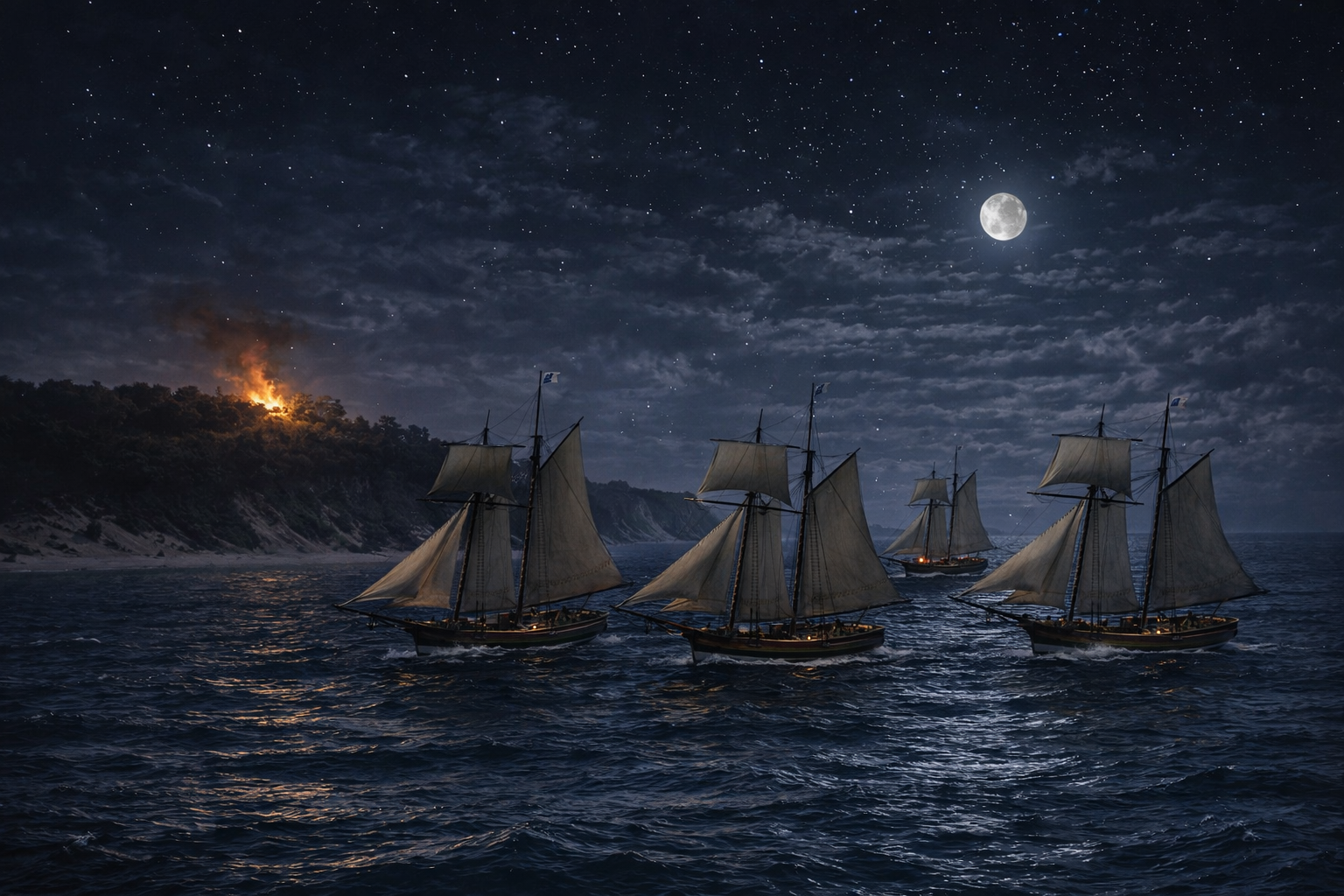
From shore, in the dark of night, people saw four or five sizable, armed vessels entering the harbor area in haste, allegedly with fire visible in the distance and guns being heard. In the emotional conditions of late March 1776, with news of the British fleet on the move, that looked like an invasion. If a fragment of the British fleet meant to plunder Plymouth, this is exactly how it might begin. James Thacher, writing later in his History of Plymouth, described the result as it was told to him: “All was confusion and alarm, military music was heard in the streets, the minute-men were summoned to arms, and sentinels were posted at their stations…soon the town was filled with armed men…”[5]
The most vivid account of this chaotic night comes from Sarah Sever of Kingston, just north of Plymouth, writing just two days later on March 23, 1776. Sever wrote that an alarm spread through Kingston when people believed the lighthouse, fort and dwellings on the Gurnet were in flames. Looking out, she saw “two large fires” in exactly that direction. Like others, she first assumed the enemy had landed and set them alight. Yet she also tried to reason with herself: if the British meant wider destruction, why would they begin by burning those buildings, thereby warning the whole countryside?[6]
Sever herself went to bed in her Kingston home, “tolerably well composed.” But Plymouth did not. The next day, Sever learned through a Plymouth friend of the fearful tumult. Guns were heard around the same time as the fires appeared. Plymouth assumed, as Kingston had, that the enemy had fired the fort at the entrance to the harbor.
A boat was sent down to discover what could be seen. When it returned, the news was dreadful: there were “three or four large ships within the Gurnet,” and they were said to be landing men “very fast.” In reality, this was almost certainly a mix of poor visibility and frightened exaggeration. It is unlikely that Captain Manley or any of the friendly vessels landed troops. The gunfire Sever described was probably part of the Gurnet’s alarm system, which used specific patterns of cannon fire to alert the town. The fires are harder to explain, but they may have been set by alarmed and confused men at the fort as an additional measure to warn the town. Whatever their origin, the combination of cannon fire, flames, and reports of enemy landings swept through Plymouth with the force of truth.[7]
And now the town tipped fully into panic. Men lit a beacon fire on Burial Hill. This triggered the alarm beacons up and down the South Shore—on Monk’s Hill in Kingston, Captain’s Hill in Duxbury, and beyond. Messengers rode to surrounding towns, some as far as Wareham and Middleborough, to summon the militia. Armed men poured toward Plymouth. Thacher described them crowding into private houses and expecting to be fed as the town’s defenders.
Meanwhile families tried to do the opposite: get out. Women and children were sent away, and furniture hurriedly removed, as much as could be managed in the dark and confusion. From our point of view it is easy to call this an overreaction. But for a town that had been on the edge for weeks, these were people reacting with the expection that British soldiers might be upon them any minute.
Sever’s friend who reported this, a Mrs. Otis, spent the night fully dressed, including winter cloak, waiting with chairs propped against the doors. From half past ten at night until half past four in the morning, they were ready to flee “in a moment.”
Then morning came, and with it the truth.
The “fleet” that had thrown Plymouth into such consternation was not a British raiding force at all. It was Captain Manley and four other American privateers, driven into the harbor by the evacuating British fleet. No landing party was storming ashore. No sack of Plymouth had begun. The terrifying ships inside the Gurnet were friends, not enemies. As Sever concluded with dry understatement, “so ended this mighty affair.”[8]
Yet the episode is more than a good anecdote. It tells us something essential about how the Revolution was actually lived on the Massachusetts coast. Even after the triumph of Evacuation Day, people in places like Plymouth did not feel secure. They knew a town might be attacked, stripped of supplies, and possibly burned. Under those conditions, rumor did not have to be rational to be powerful. On the night of March 21, 1776, Plymouth did what frightened wartime communities often do: it saw the war coming and reacted before it could be sure.
The story of Evacuation Day is often told as a clean moment of American victory—Howe gone, Boston free, the first great success of the war. But in Plymouth, four days later, the war still looked terrifyingly unfinished.
[1] Some interesting particulars of the evacuation are given in this recent post of the Massachusetts Historical Society
[2] Joseph Ward letter to John Adams, March 23, 1776, on Founders Online, originally published, in Papers of John Adams, vol. 4.
[3] Journal of HMS Niger, March 15, 1776, Naval Documents of the American Revolution, vol. 4, 349.
[4] Lt. Edmund Dodd, Log of the Diligent, March 21, 1776, Naval Documents of the American Revolution, vol. 4, 435. This event is also described in Peg Baker’s, “Sailing off to Serve,” Pilgrim Hall Museum, https://www.pilgrimhall.org/wp-content/uploads/2024/10/Sailing_Off_To_Serve.pdf
[5] James Thacher, History of the Town of Plymouth, 214.
[6] Sarah Sever letter to unknown, March 23, 1776, Naval Documents of the American Revolution, vol. 4, 474.
[7] Sever, March 23, 1776.
[8] Sever, March 23, 1776.
 Historical Digression