
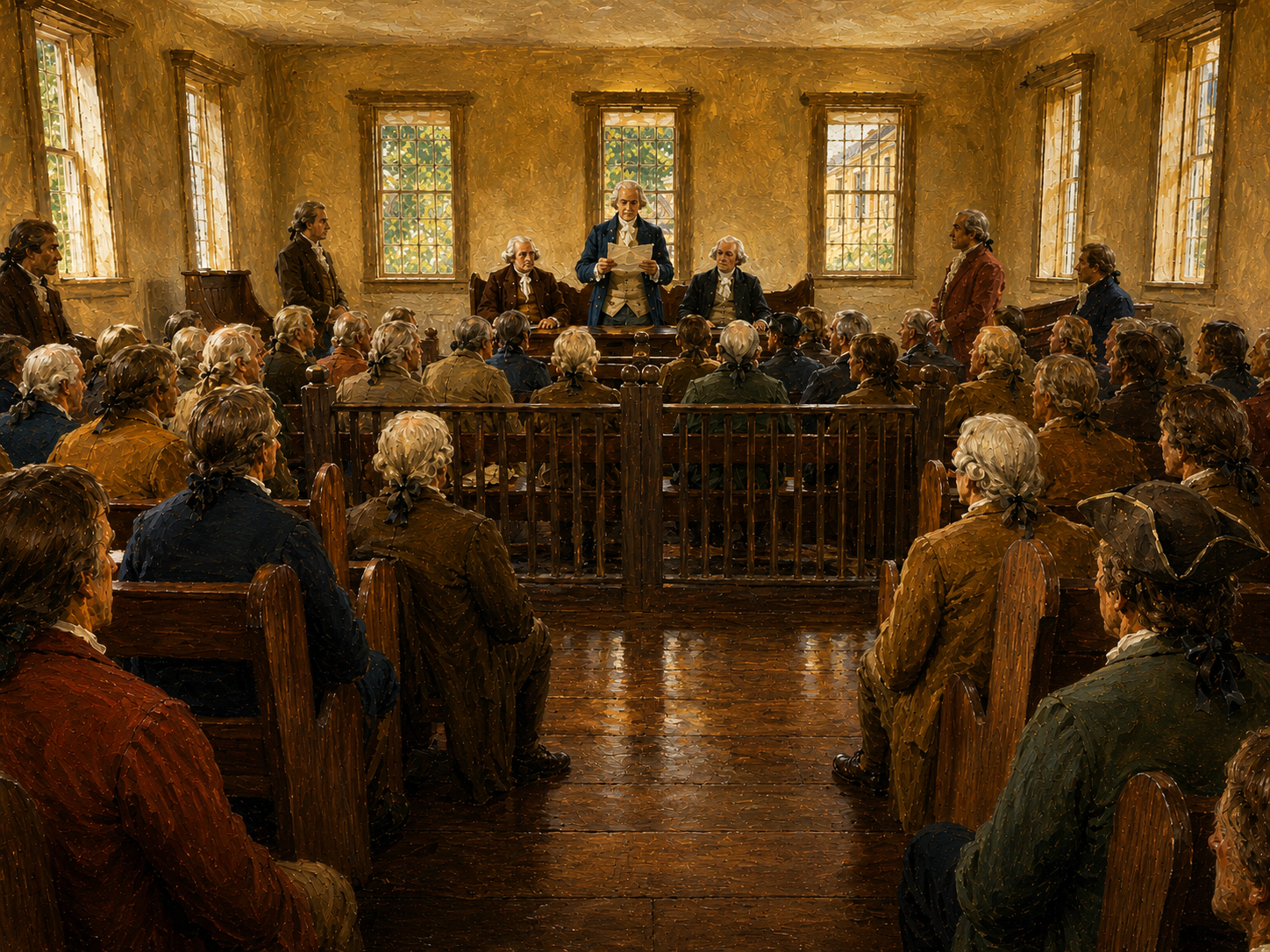
On May 20, 1776, Deacon John Torrey, a seasoned leader of the church congregation and town government in Plymouth, Massachusetts, held in his hand a document on a crucial subject—one that he had helped draft. It was Plymouth’s answer to the great question pressing upon every colony. Had the time come to declare independence?
By 1776, Deacon Torrey was nearly sixty years old, a widower, a father, a tradesman of long standing, and one of those steady, trusted men on whom Plymouth had leaned for years. Trained as a leatherworker, he had long since been elected as a deacon of the Plymouth church and a leader in town affairs. Selectman, moderator, member of the Committee of Correspondence. Now, the town had appointed him to a committee of three, including William Watson and Theophilus Cotton, to draft this important document.
Plymouth’s letter came about as a response to a dramatic state resolution. On May 9, 1776, James Warren of Plymouth, Speaker of the Massachusetts House and two other representatives were appointed to draft a resolve recommending that the towns of Massachusetts give instructions to their representatives with respect to “their sentiments relative to a Declaration of Independency.” The next day, the House adopted a stronger form of the question. They asked each town to state whether, if the Continental Congress voted to declare the colonies independent of Great Britain, they would “solemnly engage with their Lives and Fortunes,” to support Independency.[i]
Continental Congress at that time was still a long way from a Declaration of Independence, but they were laying the groundwork. On the same day that Massachusetts resolved to put the question of support for independence to the towns, Congress ordered each colony to restructure their governments so as to write out any dependence on royal authority. Colonies could not vote for independence if their governments still relied on royal officials. John Adams, who tacked on a strongly worded preamble that narrowly passed, regarded this as an essential step towards the final break.[ii]
Plymouth answered the state’s call promptly and the committee of three presented their draft instructions to the town’s newly reelected representatives at a town meeting on May 20, 1776.
Addressed to James Warren and Isaac Lothrop, the “Plymouth Instructions” began by proclaiming the town’s right to direct them to resist “the impious effort of the proud, the Imperious, and worse than Savage Court of Great Brittain which Seems to be lost to Every Sense of Justice and determined to deluge all America in Blood & carnage.”[iii] Resenting the “notoriously unjust commands” of the “Tyrranic King,” the people of Plymouth instructed their members to pursue two goals. First, “that you without Hesitation be ready to declare for Independence on Great Brittain in whom no Confidence Can be Placed,” provided Continental Congress saw fit to do so. Second, that they work to establish a new government whose form would be “Fairest to Ensure a permanent harmony to the Colonys.” They stipulated that the executive and legislative powers of this new government should not be vested in the same person. Thus, the “Plymouth Instructions” were both a declaration against Great Britain and an early statement on republican government. And in a direct answer to the state resolution, Plymouth indicated that they were indeed prepared to “Risque of our lives & fortunes.” The instructions were put to a vote and passed unanimously.[iv]
No household in Plymouth stood closer to these questions than that of James and Mercy Otis Warren. James stood at the center of Massachusetts politics as Speaker of the House. And Mercy has been urging influential friends, particularly John Adams, via letters for months. Back in November 1775, Mercy was already impatient with Congress’s hesitation. In a long letter of November 14, 1775 to John Adams, James Warren paused in conveying his thoughts about Tories to write, “She sits at the table with me, will have a paragraph of her own; says you ‘should no longer piddle at the threshold.’ It is time to leap into the theatre, to unlock the bars, and open every gate that impedes the rise and growth of the American republic.”[v] The passage is striking not only for her strong language on independence but for the domestic exchange that the letter preserves. Mercy broke into James’s letter with thoughts of her own. One can almost picture her, exasperated with caution as James wrote.
When the Declaration finally came, James Warren wrote immediately to John Adams from a recently liberated Boston to describe Declaration’s effects in Massachusetts. On July 17, he wrote, “The Declaration came on Saturday, and diffused a general Joy.” He added that the Declaration had helped “animate and inspire every one to support and defend the Independency he feels.”[vi] Towns like Plymouth had already pledged themselves to Independence. But the Declaration gave all a more concrete cause to defend.
On the same day that Warren wrote Adams, the Massachusetts Council ordered that printed copies of the Declaration be sent to the ministers of every parish, “of every denomination,” throughout the state. Each minister was to read the Declaration to his congregation after service on the first Sabbath after receiving it, and then deliver the copy to the town clerk so that it could be recorded in the town records as a “perpetual memorial.”[vii]
It is not known when the first public reading of the Declaration took place in Plymouth. However, the man most likely to have performed that duty was Rev. Chandler Robbins, minister of the First Church. No surviving record plainly states that he did so. But the order went to parish ministers, and Robbins was Plymouth’s leading minister. It is therefore reasonable to picture the Declaration reaching Plymouth as read by Robbins from his pulpit in the wooden meetinghouse that once stood where today’s stone Mayflower Meetinghouse is located.
James Thacher, surgeon’s mate in the army and future Plymouth luminary, was, like James Warren, also in Boston at that time and observing the enthusiasm. He was there among the tremendous crowd on July 18, 1776 when the Declaration was read from the balcony of the State House. The scene impressed him deeply. Regiments paraded and batteries all around Boston Harbor fired successive salutes. Even as he wrote about the festivities, Thacher also reflected at length on the precarious position of the new United States. He recorded a litany of dangers and weaknesses, noting, “We had no other laws than a kind of moderated passion; no other civil power than an honest mob; and no other protection than the temporary attachment of one man to another.”[viii] But these dire circumstance only made the Declaration all the more noble, in his view. “The history of the world cannot furnish,” he wrote, “an instance of fortitude and heroic magnanimity parallel to that displayed by the members, whose signatures are affixed to the declaration of American Independence.”[ix]
In Plymouth, the Declaration arrived in a town that had played its own part in preparing the way for it. James Warren took a leading role in the Massachusetts process that asked the towns to state their positions, once and for all, on the matter. Plymouth town meeting responded firmly and unanimously. Mercy Otis Warren urged the leap toward republican independence well before Congress made it. By the time the Declaration was read aloud, Plymouth had already made its position plain.
[i] Resolves quoted in John Henry Edmonds, “How Massachusetts Received the Declaration of Independence,” American Antiquarian Society, Proceedings, vol. 35, part 2, October 1925, 230.
[ii] Pauline Maier, American Scripture: Making the Declaration of Independence (New York: Alfred A. Knopf, 1997), 41–43.
[iii] Plymouth Town Records, vol. 3, 315.
[iv] Plymouth Town Records, vol. 3, 315.
[v] Mercy quoted in James Warren to John Adams, November 14, 1775, Warren-Adams Papers, vol. 1, 184.
[vi] James Warren to John Adams, July 17, 1775,
[vii] American Antiquarian Society, “In Congress, July 4, 1776. A Declaration by the Representatives of the United States of America, in general Congress assembled,” https://collections.americanantiquarian.org/earlyamericannewsmedia/items/show/30
[viii] Thacher, Military Journal, 49.
[ix] Thacher, Military Journal, 48.

