
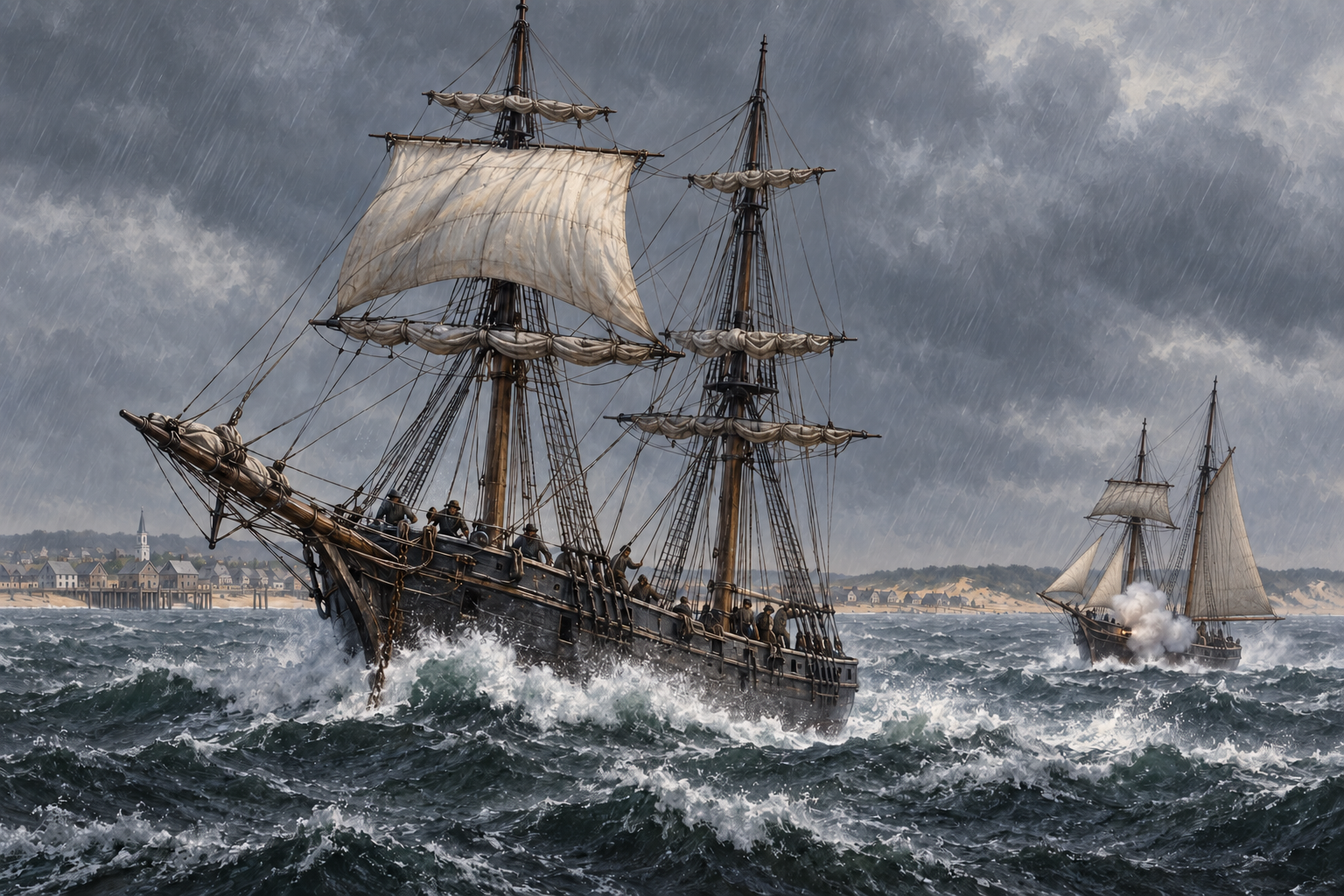
It was a custom for old shipmasters and seamen, after their seafaring days were over, occasionally to meet in Captain Doten’s counting room at the head of what is now Captain E. B. Atwood’s wharf, and while a wild northeaster howled outside they would toast their shins at a good fire, smoke their pipes, and spin yarns of privateering days, or their experiences in various voyages to the West Indies or ports across the ocean. There could be no keener enjoyment to those of younger generations than to sit while all was blue about them from the tobacco exhalations, and listen to these “tales of the sea” from men who were veritable actors in the scenes so vividly recalled.
William T. Davis, Plymouth Memories of an Octogenarian
What better on a stormy weekend than a true tale of an adventure at sea? Some 218 years ago, in 1808, Captain Samuel Doten (1783–1861) of Plymouth took advantage of a nor’easter to run the blockade during Jefferson’s embargo. My version of this tale is based on William T. Davis’s account given in his book Plymouth Memories of an Octogenarian. His tale, in turn, was based on recollections he heard directly from Capt. Doten’s son. We have each, no doubt, added a touch of embellishment in the retelling. But isn’t that how yarns are supposed to work?
In 1808, catches of cod filled many a Plymouth warehouse, while beyond New England shores the ships of two great powers went on with their war. As Britain and France caused chaos on land and sea, the U.S. government forbade American vessels to sail for any foreign ports. The embargo was meant to keep American ships out of trouble, and also to injure the economies of the warring powers to the extent that they might consider better respecting the rights of American vessels at sea. It accomplished neither goal. But it did keep many of Plymouth’s vessels from the West Indian buyers who wanted their catch. A man could walk past a fish house in Plymouth and smell a good fishing season going to waste.
William Holmes, a Plymouth merchant, owned the brig Hope, and he had managed to load his vessel with a cargo of dried fish at Provincetown. Whatever Holmes intended to do next, the customs officers at the port had guessed it. They seized the vessel and left her at anchor in the harbor, watched by a revenue cutter under Captain Thomas Nicolson, also of Plymouth. Holmes wanted to find a way to get the brig to sea, and Nicolson had orders to prevent him.
Holmes approached Capt. Samuel Doten of Plymouth to take charge of the situation. Capt. Doten was, in Davis’s telling, both a superb seafarer and a man who “liked nothing better than a bit of dare-devil business.” He knew what it cost to keep a vessel tied up. Her bills came due whether she sailed or not, and her cargo would not last forever.
Doten had already helped another Plymouth vessel escape the embargo. That had been the schooner Hannah, stripped of her sails and rigging by customs officials who believed that would sufficiently keep her from leaving the harbor. But in a night of hard rain and pitch dark, Doten and a few men had put the gear back on her, recognizing the various lines more by touch than sight. Doten had then piloted her out of Plymouth harbor, stepped off into a boat, and let her own captain carry her to Martinique.
Now, Holmes wanted Doten to somehow get the Hope out to sea not just under the eyes of customs officials, but directly under the guns of a revenue cutter. Holmes must have offered him a handsome deal. He named the men available for a crew, and Doten chose from among them.
Doten went to Provincetown and must have studied the brig Hope as one studied a locked door that needed to be opened. The fish was already in her hold. Her spars were sound. Her canvas was ready. Nicolson’s cutter lay where she could watch the brig and the way out of the harbor. Doten took charge of the Hope and began to quietly make her ready. He had picked his crew, he could make his plans, but he could not control wind.
He needed a northeaster. It would send the Hope down the harbor quickly, clear of the cutter before Nicolson could bring her round. Beyond the mouth of the harbor it would make for a rough sea, and Doten would have to work the brig around and past the Cape against the weather. He knew the bargain. A fair wind for the first few minutes might ask several days’ hard sailing in payment.
And so Doten waited. And the cutter kept her station. Surely Doten could sometimes see Capt. Nicolson on deck there. Nicolson was doing his duty and was said to be a stubborn seaman. They knew one another. Did one or the other sometimes raise a hand in salutation? Did the other return the gesture? Or did they merely pause now and then to study one another across the waters of Provincetown Harbor?
The weather stayed mild. Each morning the crew of the Hope looked up at the sky and then at Doten. Each evening the lamps appeared in the town and the tide came and went under the anchored brig.
One night the air came in wet and disagreeable. The lamps along the shore grew dim behind a blur of rain. Doten stood by the rail of the Hope until the wind had shifted steadily into the northeast. Then he called the men to work.
They ran a mooring line out astern, keeping the brig’s bow pointed toward the harbor mouth so that her square sails would fill as soon as they were set. In the darkness, men went aloft to prepare the topsails. Ordinarily, a furled square sail was held against its yard by gaskets, or short lengths of cordage passed around the gathered canvas and the spar. At Doten’s direction, these were nearly severed, leaving just enough of each intact to hold the sails in their usual furled shape. To anyone watching from the cutter, nothing in the brig’s rig would appear altered, and the sails would appear tightly furled. But at the decisive moment, the topsails could be set from the deck without sending men aloft to cast off the gaskets. Minutes mattered. Doten planned to cut and run.
Near morning the gale arrived in earnest. Rain drove against the deck. The anchored vessels tugged at their cables. On shore, people hurried with their hats held down and their collars turned up. A sensible captain would wait for better weather before putting to sea. Capt. Nicolson apparently presumed this was so as he was rowed ashore to wait out the foul weather in more hospitable conditions on land. For Doten, this was a stroke of good luck.
Some Provincetowners, resenting the revenue men, were ready to help the Hope when the opportunity came. While Capt. Nicolson and others were uptown, the ebbing tide left their boat stranded on the beach. Sympathetic townsmen stole its thole pins (the wooden pegs that served as rowlocks) and made off with an oar or two. By the time Nicolson needed to return, his gig was essentially disabled.
Doten watched from the Hope. He could not know how long Nicolson meant to remain ashore. Nor could he count on the people along the beach delaying him for long. Besides, the first officer was still aboard the cutter and in charge of her guns. The channel still had to be crossed in full view of the town.
Doten chose his moment. In the pouring rain, he called to the crew quietly. One man took his place at the halyard, another waited by the sheet. William Stacy, a mariner from Boston, stood where he could run forward as soon as the captain gave the word. The gale pulled at their coats. A gust lifted the edge of the water into a white streak between the two vessels.
Across the harbor, the cutter’s lieutenant likely kept one eye toward shore, perhaps expecting his captain’s boat to return. Doten looked toward the point and the open water beyond it. He must have thought about the difficulty of handling the brig through the weather in the open sea. Then he put his hand on the helm and gave the order. An axe severed the heavy hemp anchor cable, the stern mooring line was cut, and the Hope was free. For an instant she was nothing more than a heavy shape beginning to turn under the wind. Then the crew hauled together on the fore-topsail halyard and sheets. The weakened gaskets parted. The canvas shook open beneath the rising yard. The northeaster filled it almost at once, and the Hope began to gather speed down the harbor.
The lieutenant of the cutter must have looked in disbelief at the brig suddenly in motion without any sign of preparation. He found his musket, took aim at Capt. Doten who stood at the helm, and fired. The ball went wide. Doten held his course.
A moment later, the cutter fired one of its big guns. That shot, too, went wide, but its report carried ashore, summoning Captain Nicolson and setting Provincetown astir. Men hurried to the waterfront. The town’s seafarers immediately grasped Doten’s scheme and shouted with delight at its audacity.
On the beach, Nicolson struggled to get his sabotaged gig back into the water. Townsmen crowded around, offering to “help” but were so deliberately bumbling in doing so that they further delayed him. At last Nicolson regained his vessel, and the cutter got under way in pursuit, firing her bow guns in hopes of crippling the Hope’s spars.
The Hope was already nearing the long sandy point at the harbor mouth. She doubled the point under fire while the cutter’s shot skipped across the beach behind her, flinging clouds of sand into the air. Once outside, Doten ordered more sail set, giving him better control of the loaded brig as she entered the rougher waters of the open bay.
The chase had begun.
[Part Two, and the conclusion, tomorrow…until then, toast your shins and stay dry…]


Leave a comment