

The Great Eastern, launched in 1858, was impossibly enormous. She defied the technology of the day, a marvel that had one foot in reality and another seemingly in some sort of steampunk science-fiction realm. A vessel that pushed the envelope of what was scientifically possible in the mid 19th century was bound to be plagued by accidents and malfunctions. It is no wonder that persistent rumors surrounded the unlucky vessel alleging that she was cursed or even haunted.
The ship was designed in 1854 by Isambard Kingdom Brunel, a brilliant civil engineer and naval architect. He envisioned a passenger and cargo vessel that could steam from England to Australia or India without stopping for fuel. This concept dictated her size as she would need to be huge in order to carry enough coal. Nearly 700 feet in length, and roughly 20,000 tons, she was about five times larger (by tonnage) than any ship afloat at the time. How often has a construction record made a quantum leap of five fold? A larger ship would not be built until 1901, placing the Great Eastern about four decades ahead of her time.
The Great Eastern was designed to accommodate an astonishing 4,000 passengers, a capacity almost unimaginable in the 1850s and one that would not be surpassed for more than half a century. Modern cruise ships now commonly exceed that figure, but in Brunel’s day the scale of the vessel was without precedent.
Moving such a monster required an equally extraordinary propulsion system. Brunel gave her not one but three means of propulsion: enormous side paddle wheels, a screw propeller, and six masts carrying sails. Her hull was built entirely of iron and, even more remarkably, incorporated a double skin divided internally into watertight compartments. Features of this sort would become commonplace in later ships, but in the 1850s they were strikingly innovative.
A friend supposedly told Brunel during construction that “the world hasn’t grown up to her” and suggested that he simply turn the enormous unfinished vessel into a pier. Whether or not the remark was entirely serious, it proved remarkably perceptive.
Even launching the ship became an engineering crisis. The Thames at Millwall was too narrow to permit a conventional stern-first launch, so the Great Eastern had to be built parallel to the river and launched sideways. Her hull weighed more than 12,000 tons. When the first launching attempt was made in November 1857, the ship moved only a few feet before becoming stuck. Machinery failed, men were injured, and the enormous vessel remained stubbornly on the ways. It took nearly three more months of hydraulic rams, chains, cables, and repeated attempts before she was finally floated in January 1858.
The ordeal became another chapter in the growing legend of an unlucky ship.
The project also proved financially ruinous. Costs soared, companies failed, and the relationship between Brunel and John Scott Russell deteriorated badly. Six men reportedly died during the ship’s construction, and further deaths followed during her early career.
Brunel himself did not live to see what became of his creation. On September 5, 1859, while visiting the Great Eastern shortly before her sea trials, he suffered a severe stroke. Four days later, during the trials, one of the ship’s boilers exploded. The blast wrecked portions of the elegant passenger accommodations and killed six men. Brunel, already gravely ill at home, died on September 15 at the age of fifty-three.
The Great Eastern finally made her first voyage to New York in June 1860. By then, however, the assumptions behind Brunel’s original design were already becoming obsolete. Improvements in the network of coaling stations around the world made it increasingly unnecessary for a steamship to carry enough coal for an entire voyage to India or Australia. The very feature that had justified the ship’s colossal dimensions was losing its economic advantage.
Instead, the Great Eastern was placed in Atlantic passenger service.
It was not a success.
She was enormously expensive to operate, difficult to fill with passengers, and too large for many existing docks and port facilities. Again and again, the problem was not that Brunel’s engineering had failed. The world simply had not yet developed the infrastructure—or the demand—to make economical use of a ship of such extraordinary size.
Her reputation for misfortune continued.
During an Atlantic crossing in 1861, the Great Eastern encountered a violent storm that damaged her steering apparatus and paddle wheels, leaving the huge vessel difficult to control. The following year she struck an uncharted rock near Long Island while approaching New York.
The collision tore a gash in her outer hull roughly eighty feet long.
A similar wound might have doomed a conventionally constructed ship. But Brunel’s double hull did exactly what it had been designed to do. The inner hull remained intact, and the Great Eastern reached port safely. In one of the great ironies of her career, an accident that might have reinforced her reputation as an unlucky ship instead demonstrated just how far ahead of his time Brunel had been.
There were stranger stories as well.
During the ship’s early voyages, crewmen and passengers reportedly heard a persistent pounding or hammering sound that seemed to come from within the enormous double hull. The noise helped inspire a gruesome legend: during construction, so the story went, a workman had disappeared and been accidentally sealed between the two layers of iron plating. His ghost now hammered endlessly from within, still trying to escape.
There is evidence that unexplained noises aboard the vessel genuinely troubled members of the crew, although the supernatural explanation was unnecessary. After the Long Island accident, repairs revealed that at least some of the mysterious pounding had been caused by loose or damaged machinery associated with one of the paddle wheels.
The legend nevertheless survived. According to another story, when the Great Eastern was finally broken apart decades later, workers discovered a human skeleton trapped inside the hull. There is no reliable evidence that this ever happened.
By the mid-1860s, it had become clear that the Great Eastern was a commercial failure as a passenger liner. But then something remarkable happened. The very qualities that had made her impractical for ordinary passenger service made her uniquely suited to one of the greatest technological projects of the age: laying submarine telegraph cable across the Atlantic Ocean.
These new trans-Atlantic telegraph lines required thousands of miles of heavy cable that had to be carried aboard a single vessel and paid out continuously into the ocean. There was scarcely another ship in existence capable of carrying so much of it.
In 1865 the Great Eastern attempted to lay a cable between Ireland and Newfoundland. The expedition nearly succeeded, but after more than a thousand miles had been laid, the cable broke and disappeared into the depths of the Atlantic.
They tried again the following year. In 1866 the Great Eastern successfully laid a new cable across the Atlantic, establishing a durable telegraph connection between Europe and North America. Messages that had once required ships and weeks of travel could now cross the ocean in minutes.
Then the crew did something even more extraordinary. The Great Eastern returned to the Atlantic, searched for the cable lost the previous year, grappled for it thousands of feet beneath the surface, hauled it back aboard, spliced it, and completed that line as well.
Suddenly Brunel’s gigantic ship no longer seemed quite so absurd.
She went on to lay thousands of miles of submarine cable in the Atlantic and elsewhere. In 1869 she participated in laying a French trans-Atlantic cable that reached the United States at Duxbury, Massachusetts…an interesting local connection for those of us on the South Shore.
It was, in a sense, the role for which the Great Eastern had been waiting. Her passenger career had demonstrated how difficult it was for the world of the 1860s to make use of a ship of her dimensions. Cable laying turned her enormous carrying capacity into an advantage. Brunel had built a ship for a world that did not yet exist. But for a brief period, the telecommunications revolution caught up with him.
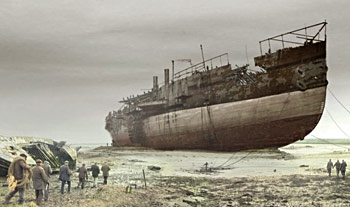
Even so, the Great Eastern never became a great financial success. After her cable-laying career ended, she was laid up at Milford Haven for years. During the 1880s she was brought to Liverpool and reduced to the rather melancholy role of floating exhibition hall and advertising platform.
Eventually she was sold for scrap. The dismantling began on the Mersey in 1889 and proved predictably difficult. Brunel had built the ship exceedingly well. Tearing apart her massive double iron hull took many months of labor.
There was one final, fitting connection between the Great Eastern and the technological imagination of the nineteenth century.
During one of her cable laying voyages in 1867, a French author named Jules Verne traveled on the Great Eastern. The voyage inspired him to write a novel called A Floating City which was set on board the huge vessel. And I have little doubt that Brunel’s staggering achievement, something almost too impossible to exist at that time, set Verne to contemplating what other technological marvels might soon be achieved by engineers. Perhaps there is even a little bit of the Great Eastern in the Nautilus of Verne’s Twenty Thousand Leagues Under the Sea written three years after his voyage.
For years, the Great Eastern was remembered largely as an engineering folly: too big, too expensive, too unlucky, and too far ahead of her time.
But perhaps that last judgment is the most important.
The Great Eastern was not simply a failure. In many respects, the world had not yet grown up to her.
[Sources: David Allen Butler, The Age of Cunard, (2004), p. 96-97; Angus Konstam, Ghost Ships: Tales of Abandoned, Doomed, Haunted Vessels, (2007), p. 45-48.]

