
If you have not read Part One of this tale, you might want to do that first, click here. My telling is based on William T. Davis’s account in Plymouth Memories of an Octogenarian. His, in turn, was based on what he had heard from Capt. Doten’s son, Charles C. Doten, and Doten’s wife, Rebecca Doten. Like most tales passed from one teller to another, it no doubt gathered a little embellishment along the way—including a modest degree of narrative polish in my own version.
Capt. Samuel Doten of Plymouth gripped the helm of the brig Hope as rain washed across his face and found its way beneath his collar. The nor’easter drove them forward as he had hoped, the gale howling at his back. His vessel was loaded with dried fish that would bring a handsome profit in the West Indies if he could evade the revenue cutter behind them, and defy the embargo. The storm that would have kept any sensible captain at anchor was precisely the opportunity Doten had been waiting for.
Provincetown’s Long Point lay ahead, a pale strip of sand against a darkening sea. There was no lighthouse on it then, and no row of houses to mark its further end. As the Hope rounded the point at the harbor mouth, she passed beyond the shelter of Provincetown and into the heavier seas of Cape Cod Bay. As she did so, the revenue cutter’s guns continued to fire. With each shot, the soaked crew of the Hope glanced up to see if the shot had smashed the brig’s spars, or parted rigging. Instead, they caught glimpses of sand spraying up from the point behind them as the balls fell short.
The cutter’s commander, whom Davis identified as Captain Thomas Nicolson of Plymouth, was not prepared to abandon the chase. His gunners tried to cripple the Hope’s spars, but the mounting seas spoiled their aim. Nicolson nevertheless pressed on, determined at least to keep the brig in sight.
Once in the open water, the tremendous surf added its roar to the wind, making orders impossible to hear. On the Hope the men passed instructions by gestures or calling into one another’s ears. Doten ordered more sail to give him better command of the brig. William Stacy went up to loose a topgallant sail. The shrouds moved under him, and the wind pressed his clothes against his back. He reached the crosstrees and continued to climb higher.
As he did so, a round shot shrieked past so close that its rush swept his feet from the rigging. Then the wind caught him and for a moment he streamed out almost horizontally, his hands locked around the shrouds and his boots kicking at empty air, “like a flag,” Davis wrote. Stacy regained his footing, looked back toward the cutter, and shouted, “A good shot. Try it again!” Then he continued aloft. His bravery drew a shout from the crew on deck, quickly lost under the gale.
The sea grew still rougher as both vessels labored around Race Point and fully left the shelter of the Cape. The cutter’s guns could no longer be aimed with much purpose. Nicolson kept her in pursuit. At times the Hope rose on a swell and Doten could see the whole length of her pursuer, and at times only a mast showed beyond the gray water.
The same northeast gale that had so swiftly carried the Hope from Provincetown harbor now hindered their way to the open Atlantic. The brig had to beat to windward, clawing ahead on one slanting tack and then another. All afternoon the crew hauled at sodden braces and sheets with numbed fingers, swinging the yards and trimming sail while the deck plunged beneath their feet. Each tack demanded hard labor and bought only a little ground. Every time Doten looked toward the Cape it seemed to have moved very little. They went on working toward clear sea, one maneuver at a time.
Night came without an end to the chase. At one point, the lights of the cutter disappeared behind curtains of rain. The men waited for her to show again. She did, some distance astern. But later she was gone. There was only darkness astern. Doten kept the Hope to her work past Cape Cod. He could not tell whether Nicolson had fallen back, turned for shelter, or was still following where nobody aboard the brig could see him.
Doten learned much later, according to Davis, that the cutter had gone ashore near Scituate that night and was wrecked. All her hands survived. Davis does not explain how she came there. In theory, Nicolson may have abandoned the chase and turned toward Boston, only to have the gale push the cutter south of her intended course and onto the Scituate shore. However, there is a bit of a historical problem with this part of Davis’s tale (see endnote below).
In the weather off the Cape, Doten knew none of this. He counted his own men, watched his canvas, and waited for a little more room between the Hope and the coast. After a day or two the worst of the gale was behind them. The Atlantic opened before the brig, and Doten set his course for the West Indies.
Holmes had loaded his fish to sell, and Martinique was the market Doten hoped to reach. France and Britain were at war, and a merchant captain crossing between their islands could find one power watching the ports of the other. For a while the Hope had sea enough about her to put that thought aside.
Her days fell into the small regularities of a passage. The men dried their clothes and repaired lines chafed in the storm. Stacy’s narrow escape became a story to be told and retold in the focsle and in taverns. Each telling likely brought the ball a little nearer.
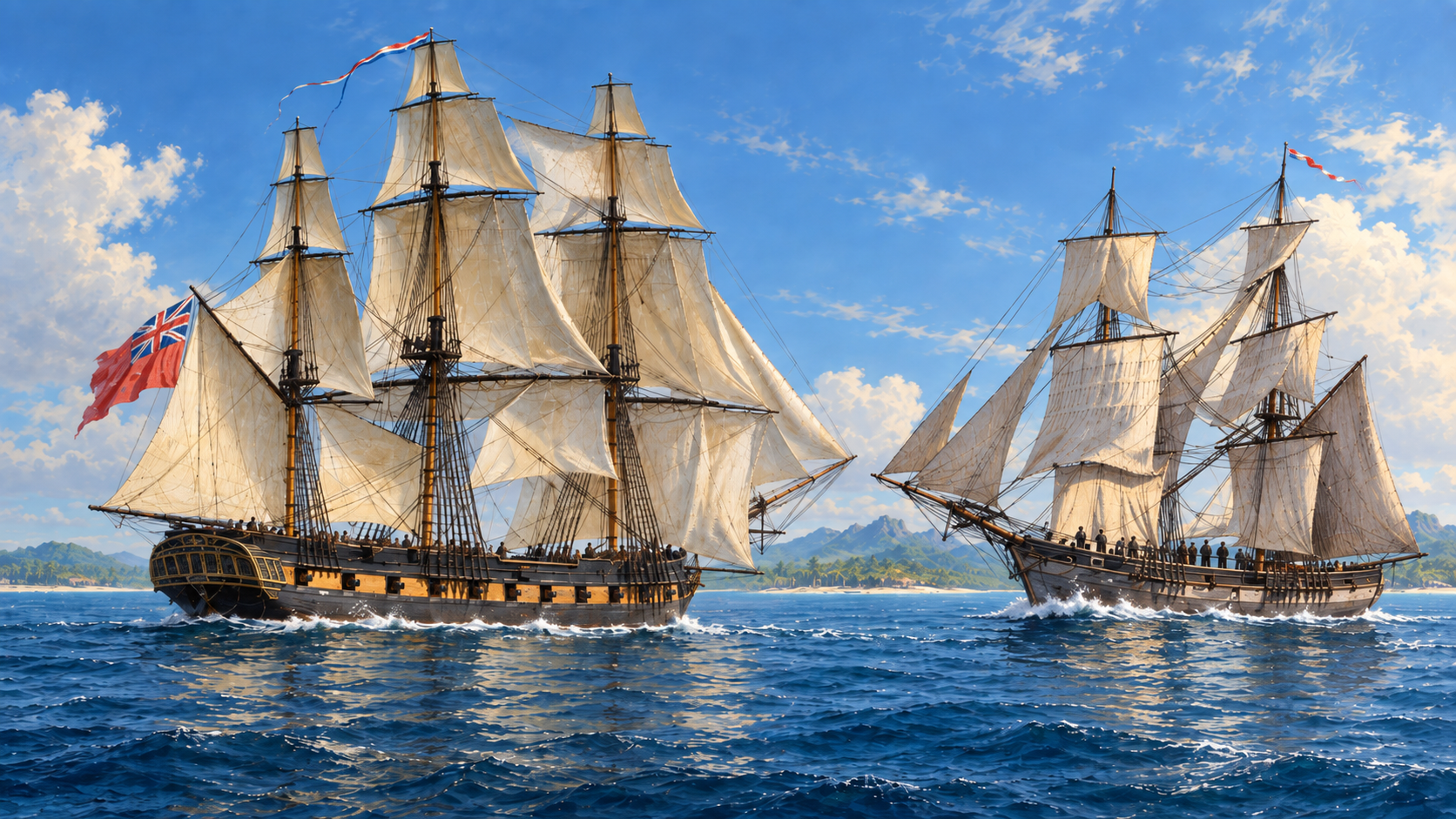
Martinique was nearly within reach when, one afternoon, the bow of a great frigate slid from behind an island directly ahead. More of her followed. Towering masts, broad yards, and a long row of gunports, until she lay squarely across the Hope’s path. A flash broke from her side. Seconds later, the report rolled across the water, ordering the brig to heave to. Doten had defied a revenue cutter. A British frigate was another matter. He ordered the Hope hove to and watched as one of the warship’s boats dropped into the sea and pulled toward him with a boarding officer and his men.
The boarding officer climbed over the rail with several men behind him while their boat rose and fell against the Hope’s side. He found Doten waiting on deck. The officer asked where Doten was bound.
“West Indies and a market,” Doten replied.
The answer might have served in another conversation. But the officer knew he meant French-held Martinque. At Martinique, he told Doten, the French would have paid twenty-five dollars a quintal for his fish. At British-held St. Lucia, he could expect only sixteen.
Doten agreed to go to St. Lucia and prepared to bid the officer farewell. But the officer was not persuaded. He indicated he was sure that Doten would go to St. Lucia, but nonetheless, the frigate would be going with him. According to Davis, the officer knew that Yankees were “altogether too smart and slippery” to be trusted alone.
As they resumed sail, Doten looked across at the frigate and then at his own men. Nine dollars a quintal was a great deal to surrender, but there was no chart that showed a passage through a British frigate.
In St. Lucia, the fish came out of the hold into the Caribbean heat. It had been caught in northern waters, dried, loaded at Provincetown, and carried past the cutter and through a gale. Now it was weighed and sold at the price the frigate had allowed.
He sold the brig as well. The Hope stayed there when he left, a vessel gone from his charge and from Holmes’s books. There were accounts to settle back in Plymouth. There was also the business of carrying home what he had received.
As a precaution, Doten sewed a large part of the proceeds, in Spanish doubloons, into the lining of his clothing. On the return journey he travelled with the weight of it against him, hoping that, if they happened to be boarded by a less courteous party than the British, his fortune might go unnoticed.
Some weeks later, Doten reached Plymouth and in the middle of the night, he walked to his house at the foot of the Training Green. The street was quiet and dark. When he knocked, Rebecca came to the door and found him on the step, salt-worn and tired. They went inside.
The gold could not wait until breakfast. Sitting up together in bed, they unpicked the seams of his travel-stained clothes and worked the heavy coins from the lining, one by one. Each fell with a muffled clink upon the blankets, catching what little light there was, until a gleaming pile of Spanish gold rose between them.
Years afterward, when a nor’easter rattled the windows of Doten’s counting room and the old seamen drew their chairs toward the fire, the tale was good for another telling. Some would remember Stacy high in the rigging, some the sand thrown up from Long Point at Provincetown, and some the cutter lost in the dark. Rebecca remembered opening the door at two in the morning, the sound the coins made when they fell upon the pile, and her husband being home.
[Historical note: As noted above, the key elements of this tale were presented by Davis as having been told to him by Capt. Doten’s wife and son. They may or may not have actually taken place. Capt. Doten did have a reputation, it seems, as a daredevil and probably was successful at evading the embargo. Based on research so far, however, there was no Plymouth Capt. Nicolson opposing him on the deck of the revenue cutter. No record can be located of a revenue officer of that name at present. Nor is there a record of a cutter running aground at Scituate. But let’s not let these details get in the way of a good story…Throw another log on the fire.]

